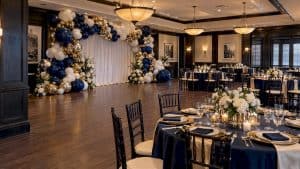
A safe balloon installation is anchored for its height and for the weather. It leaves every exit, aisle and sprinkler clear. It is built by a crew that handles helium, ladders and power with care, and it is inspected during the event and fully removed afterward. If you are hiring a balloon artist for a corporate launch, a grand opening, a luxury baby shower or a first birthday anywhere in metro Atlanta, this guide shows you what to ask for and what a professional install looks like.
We are Atlanta Balloon Designer, based in Austell in Cobb County, and we style events across the metro area and out to roughly 60 miles. Stunning décor should never be a hazard, so this guide is the checklist we want every planner to hold us to.
TL;DR
- Match the anchoring to the structure’s height and the site: a base that works indoors on carpet is not enough on a breezy Atlanta patio.
- Keep balloons away from exits, fire alarms, sprinklers, electrical equipment and walkways, and keep aisles at least 44 inches wide.
- Latex balloons, whole or broken, are a choking hazard for children under 8, so plan supervision and fast cleanup.
- Helium cylinders must be secured upright, and foil balloons must stay away from electrical sources.
- Safe teardown means clearing guests first, then removing every weight, tie, clip and fragment.
Table of Contents
- Why Balloon Installation Safety Matters More Than It Looks
- Anchoring Arches, Garlands and Freestanding Pieces
- Keep Exits, Aisles and Safety Equipment Clear
- Attaching Balloon Décor to Walls Without Damage
- Weather and Site Conditions for Outdoor Installs
- Helium, Cylinders, Ladders and Tools: What a Safe Crew Does
- Children, Guests and Busy Areas
- Safety Differences by Event Type
- Inspection During the Event
- Safe Removal and Teardown
- A Hire-Ready Safety Checklist for Planners
- Plan a Safe, Stunning Installation With Us
- FAQ
- Sources
Why Balloon Installation Safety Matters More Than It Looks
Balloon décor looks light, but a large installation is a structure. It has a frame or a line, an anchor, a footprint in a room, and hundreds of small pieces that can end up on the floor. A 10-foot organic arch at a hotel ballroom entrance is a tall, wide object in a space where hundreds of guests move at once. A garland on a staircase sits right where people walk, carry drinks and wear heels.
Planners in corporate settings already think this way about staging, signage and trusses. The same mindset applies to balloons. Venue managers, risk officers and HR teams increasingly ask for rigging details, and a professional should answer without hesitation. For Fortune 500 events, grand openings and hotel functions, the safety conversation is part of a smooth load-in, not an obstacle to creativity.
We also see the other side. Families planning first birthdays and baby showers want gorgeous photos and want to know toddlers and grandparents will be safe around the display. The good news: nearly every risk below has a simple, known fix.
Anchoring Arches, Garlands and Freestanding Pieces
The first rule is that every freestanding installation needs a base sized for its height, width and location. A tall arch acts like a sail. A heavy-looking base that sits on a slick floor can still slide, and a narrow base on grass can still tip.
Here is how we think about it by installation type:
- Freestanding arches and spirals: a weighted base or a frame secured to weights at both feet. Taller and wider means heavier.
- Columns: a wide, weighted foot plate, with the column kept out of high-traffic corners where guests will brush past it.
- Marquee letters and big letters: a stable stand or a wall or backdrop mount, never leaning on furniture.
- Garlands: attached along a continuous support line, with the anchor points chosen for the surface they sit on.
- Backdrops and photo walls: braced from behind, with the footprint kept clear of cables and chair legs.
Weights themselves can be a trip hazard. We position bases so guests and servers walk around them naturally, tuck them behind the installation where the design allows, and cover or style them so they are visible rather than hidden. A weight nobody sees is a weight somebody trips on.
On lawns, gardens and similar soft ground, a base alone is rarely the whole answer. Professionals stake the frame into the ground as well. Our outdoor balloon décor planner’s guide goes deeper on that setup.

If you want to understand how different designs behave structurally, our overview of types of balloon arch designs explains why a spiral, a stacked arch and an organic arch each need a slightly different support plan.
Keep Exits, Aisles and Safety Equipment Clear
This is the section venue managers read first. Balloon arches, garlands and walls should never block doors or emergency exits, cover fire alarms or sprinklers, interfere with electrical equipment, obstruct walkways, create trip hazards with stands or weights, or be attached to surfaces that cannot safely support them. We put that as a standing rule in every plan, and it matches what event safety guidance asks of any décor.
A university event-management safety checklist from Ohio State calls for exits and the paths to them to stay unobstructed, with aisles at least 44 inches wide. That is an excellent working number for balloon placement. When we draw a floor plan, we measure from the installation’s widest point, not from the frame, because balloons bulge past the structure.
A few placement habits we follow:
- Walk the exits. We identify every marked exit and the route to it before choosing an arch location.
- Look up. Sprinkler heads, smoke detectors and HVAC vents decide how high and how close a garland can go. Balloons never cover them.
- Respect the queue. An entrance arch is beautiful, but registration lines form under it. We leave room so a line can stand without spilling into a hallway.
- Mind the service paths. Caterers, bartenders and AV crews need lanes. We confirm them with the venue.
This is also why early venue coordination matters. Hotels, convention centers and commercial properties around Atlanta each have their own load-in rules, fire marshal expectations and approved attachment methods. Our venue coordination guide for planners walks through what to confirm and when.
A Quick Floor-Plan Check Before You Approve a Design
Before you sign off on a layout, ask these questions of any balloon vendor:
- Where are the nearest exits, and how many inches of clear path remain beside the installation?
- Is anything attached to or near a sprinkler, alarm, camera or light fixture?
- How are the weights or stakes placed, and are they out of the walking path?
- Does the venue need to approve the attachment method in writing?
A clear answer to all four is a good sign. We provide these details as part of our planning, including floor plans, timelines and vendor coordination.
Attaching Balloon Décor to Walls Without Damage
Wall installs are popular for corporate step-and-repeat alternatives, branded backdrops and photo walls. The safety question is twofold: will the attachment hold, and will it leave the wall as it was?
The basic principles are simple. Adhesive hooks and strips are meant for light loads, and a full garland of balloons strung together adds up. That is why balloons are strung on a line and the line is distributed across several attachment points, rather than hung from one hook. The surface matters too: clean, sealed, smooth finishes behave differently from textured paint, brick, wallpaper or fabric panels.
Our approach on wall work:
- Ask the venue first. Many venues have rules on tape, hooks, nails and anything touching painted surfaces. Written approval prevents surprises at load-out.
- Use rated, venue-friendly mounting appropriate for the surface, and spread the load across several points.
- Never attach to anything that cannot bear weight, such as decorative trim, light fixtures, sprinkler pipes, glass fixtures or ceiling tiles.
- Remove gently. Releasing adhesive slowly, rather than yanking it off, protects the finish. Our crew handles removal so your venue deposit stays safe.
For outdoor walls, fences and soffits, moisture, sun and wind change everything. Adhesives that work in an air-conditioned lobby may fail on a sun-baked Georgia afternoon, which is another reason we offer a site visit for $250 when the surface or layout is complicated.
Staircase installs deserve their own note, because they combine height, foot traffic and handrails. Our staircase balloon garland guide covers what a professional crew considers there.
Weather and Site Conditions for Outdoor Installs
Atlanta outdoor events face a predictable set of problems: afternoon gusts, sudden summer storms, hot sun, and uneven lawns or sloped patios. A balloon installation outdoors should be treated as a wind-loaded structure.
Before install day, we check:
- Forecast wind and storms. If conditions are beyond safe limits, we work with you on a backup: an indoor location, a lower and wider design, or a different time.
- Placement relative to wind. A wall, building or hedge behind the installation helps. A wide-open corner of a lawn does not.
- Ground type. Pavers, grass, deck boards and sloped concrete each call for a different anchoring plan.
- Heat and direct sun. Latex can weaken with heat and sun, so we plan install timing and shade accordingly. Delivering as close to the event as practical helps.
- Overhead hazards. Tree limbs, tent edges and especially power lines. Foil balloons can conduct electricity, so we keep them away from overhead lines, outlets, exposed wiring and light fixtures. If a balloon of any kind ever gets caught in a power line, nobody should attempt to retrieve it. Call the utility.
A good vendor will tell you honestly when a design should be lowered, widened or moved. That conversation is a sign of experience.
Helium, Cylinders, Ladders and Tools: What a Safe Crew Does
Most guests never see this part, but it is where a professional crew separates itself. Installing large pieces means handling compressed gas, working at height and sometimes running lighting or LED elements.
Helium cylinders
Compressed gas cylinders should be stored upright and secured against tipping or rolling with non-combustible restraints such as chains or metal straps anchored to fixed supports. That requirement traces to OSHA 1926.350(a)(9) and CGA P-1, as a gas supplier explains. Other safety handbooks add the practical details: store cylinders in well-ventilated, dry areas, away from combustibles, with valve caps in place unless in use, and move them by tilting and rolling on the bottom edge rather than dragging or dropping them.
On use, one utility contractor guide says to secure cylinders at about two thirds of their height with a chain, coated cable or cylinder strap. The same guide says never to use grease or oil on regulator or cylinder valves, to open the valve slowly with the proper regulator in place, never to leave a valve partway open, and to keep the cylinder clear of sparks, flames and electrical circuits.
Transport matters as well. A cylinder rolling around a van is a hazard, so cylinders ride upright and restrained.
Breathing helium is never a party trick
Helium displaces oxygen. Guests, especially teens and kids, should never inhale from a balloon, tank or regulator. At a family event, we recommend keeping the inflation area behind the scenes and away from curious hands.
Ladders, tools and power
Our crews handle ladders and lifts with care, keep tool bags and cutting tools off the floor of public areas, and work around guests only when the area is cordoned off. Anything that involves power, such as LED marquee letters, lighting or illuminated backdrops, gets cables routed out of walking paths, covered or taped where they must cross, and kept away from balloons and wet areas. If a venue requires a licensed electrician or its own AV team for power, we coordinate with them.
Chandelier-style installs add overhead rigging questions of their own. See our balloon chandelier installation guide for how those are planned for Atlanta venues.
Children, Guests and Busy Areas
First birthdays, baby showers and school events bring the youngest guests, and that changes the safety plan.
Latex balloons carry a federally required choking warning. Under 16 CFR 1500.19, the label must tell buyers that children under 8 can choke or suffocate on uninflated or broken balloons, that adult supervision is required, and that broken balloons should be discarded at once. A law firm that summarizes these rules adds that balloons are excluded from the small-parts ban for toys for children under three, with only a warning label required. The same page notes that balloons cause more pediatric choking deaths than any other non-food consumer product, and that broken pieces can seal an airway in a way that is hard to clear. That is why we take cleanup seriously.
What that means in practice for a family event:
- Assign a watcher. Have one adult responsible for the balloon area during the party, especially when toddlers are walking.
- Place installations out of reach where it matters. A backdrop against a wall is easier to supervise than a garland at floor level.
- Pick up fast. If a balloon pops, collect every fragment immediately. Our team can tell your host or venue coordinator how to do this.
- Keep uninflated balloons away from children. Party favors, craft stations and balloon twisting entertainment all need an adult nearby.
- Mention latex allergies. Latex can cause allergic reactions in some people. If a guest has an allergy, tell your designer in advance so we can discuss alternatives for their area of the event.
For corporate events, the child factor is smaller, but the crowd factor is larger. Registration areas, photo ops and brand activations create bottlenecks. We design photo backdrops with generous standing room for the line and the photographer. Our conference photo backdrop guide explains sizing for that.
Entertainment venues and active play
If the celebration is at a play-focused venue where guests run, throw or compete, balloon pieces should sit in low-contact zones such as entry tables, party rooms and photo corners. Planning tournament party ideas around active games works best when the décor frames the space instead of crowding the play area.
Safety Differences by Event Type
| Event | Main risk | What we plan for |
|---|---|---|
| Corporate conference or trade show | Crowds, queues, cables, venue rules | Wide standing room, venue-approved attachments, clear aisles |
| Grand opening | Street-facing exposure, wind, foot traffic | Weighted or staked bases, placement away from doors and walkways |
| Hotel or convention center | Fire code, load-in windows, ceiling limits | Early coordination, no coverage of alarms or sprinklers |
| First birthday | Toddlers, broken pieces | Supervised zone, fast cleanup, backdrops placed against walls |
| Luxury baby shower | Guests in heels, elegant tablescapes with candles | Clear paths, balloons kept away from flames and heat |
| Outdoor celebration | Wind, sun, uneven ground | Staked anchoring, shade-aware timing, a weather backup |
Candles deserve a short extra note. Latex and open flame do not mix. We style luxury tablescapes with candles and LED elements, and we keep balloons well away from any flame. LED candles are an elegant option when a table sits close to a balloon piece.
Inspection During the Event
A good install does not end when the crew leaves. For long events, a quick check by a designated person catches small issues early.
- Is the base still firmly in place, with no weights shifted into a walkway?
- Has a guest moved a prop or leaned on a stand?
- Are there fallen balloon pieces on the floor?
- Is the installation still clear of exits, doors, fixtures and equipment?
- Outdoors, has the wind changed or picked up?
We give our clients a short contact path for the event day, so a venue manager or host can reach us if something needs attention.
Safe Removal and Teardown
Removal is where many rushed installs go wrong. Event planning guidance, in this case a council guide from England, calls for controlled de-rigging and a post-event inspection. Applied to balloons, the sequence we follow is:
- Clear guests from the work area. No one stands under or beside a structure being dismantled.
- Unload the balloons first. We take the balloons off before repairing or dismantling any structural support.
- Remove everything. Weights, ties, line, clips, stakes and balloon fragments all leave with us.
- Inspect the site. A final walk-through confirms nothing remains as a trip, choking or obstruction hazard, and that walls and floors are as the venue gave them to us.
- Dispose properly. Broken latex and loose pieces go in bags, away from children and wildlife.
Our delivery, setup and strike-down service starts from $125, so that every step above is handled by a trained crew, not left to the host at midnight. Learn more in our delivery and setup guide.
A Hire-Ready Safety Checklist for Planners
Use this when you compare proposals or brief a designer:
- Site details: Do they ask about the venue, surface, ceiling height, exits and weather exposure?
- Anchoring plan: Can they explain how each piece is weighted, staked or mounted?
- Venue approvals: Will they follow the venue’s rules and provide any documents the venue requests?
- Placement plan: Will they provide a floor plan or mockup showing aisles and clearances?
- Crew process: Do they handle gas cylinders, ladders and power safely?
- Timeline: Is there a load-in window, a mid-event contact and a scheduled strike?
- Cleanup: Do they remove all debris and hardware?
We prepare digital mockups so you can see placement before it is built. A mockup is $75 each, which helps your venue contact, your safety lead and your executive sponsor approve the layout early.
Our Perspective: Beautiful and Secure Go Together
Safety is part of design, not a layer on top of it. When we plan an arch or a garland, the weight plan, the walkway width and the teardown sequence are drawn on the same page as the colors and textures.
Luxury is about confidence. Your guests feel it when an entrance arch stands perfectly still, when the photo wall has room for a line, and when the venue manager nods at the floor plan. That is why we pair our design work with planning, vendor coordination, timelines and site visits, so there are no surprises on the day.
Our team has styled events for corporate clients and in major Atlanta venues, and the lesson repeats: the best installs are the ones nobody worries about. Tell us your venue, your guest count and your vision, and we will build something stunning and secure around it.
Kay
Plan a Safe, Stunning Installation With Us
We design custom balloon arches, garlands, columns, backdrops, marquee letters and immersive installations, with full-service planning for corporate events, grand openings, baby showers and birthdays across metro Atlanta, including Austell, Marietta, Smyrna, Brookhaven and nearby communities. Published starting prices include a Spiral Balloon Arch or 24 ft Stacked Arch from $600, an Organic Balloon Arch from $700, a Luxury Organic Balloon Arch from $1000, and delivery, setup and strike down from $125. See the full list on our balloon decor pricing page.

Ready to talk about your event? Call us at 678.203.0200, explore our corporate and event services, or book a design consultation. Book now and let us make your celebration unforgettable, and secure from load-in to strike.
FAQ
How do you keep a balloon arch from falling over at an outdoor event?
The base has to match the arch’s height and the ground it stands on, and on grass or soil the frame should also be staked. Placing the arch with a wall or hedge at its back and keeping the design lower and wider also helps. Your designer should check the forecast and offer a backup plan.
Are balloon installations safe around toddlers and babies?
Yes, with supervision and cleanup. Latex balloons carry a federal choking warning for children under 8, so assign an adult to the balloon area, keep uninflated balloons away from children, and collect broken pieces immediately.
Can balloons block emergency exits or sprinklers?
They must not. Installations should stay clear of doors, exits, fire alarms, sprinklers, electrical equipment and walkways, with aisles kept at least 44 inches wide. A floor plan or digital mockup lets your venue approve the layout before install day.
Is helium dangerous?
Helium is safe when handled properly, but it displaces oxygen, so nobody should ever inhale it from a balloon or tank. Cylinders must be stored upright and secured against tipping, which is why professional crews handle all gas at your event.
Who removes the balloons and hardware after the event?
With our delivery, setup and strike down service, we do. We clear the work area, take down the balloons, remove weights, ties, clips and fragments, and check the site before we leave.
Sources
- Event Management Safety Checklist, Ohio State University
- Storage of helium gas cylinders, Spec Gas Inc.
- 2026 Contractor Safety Handbook, Grant PUD
- Safety Essentials, OGE
- Choking Hazards Beyond Food: Balloons, Coins, and Tiny Toy Parts, Swartz & Swartz
- Event planning guidance 2025, Runnymede Borough Council