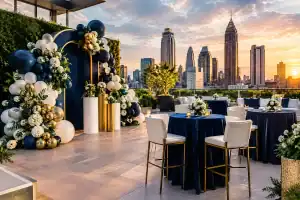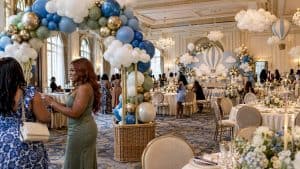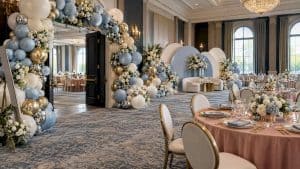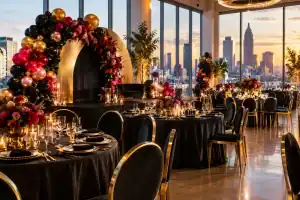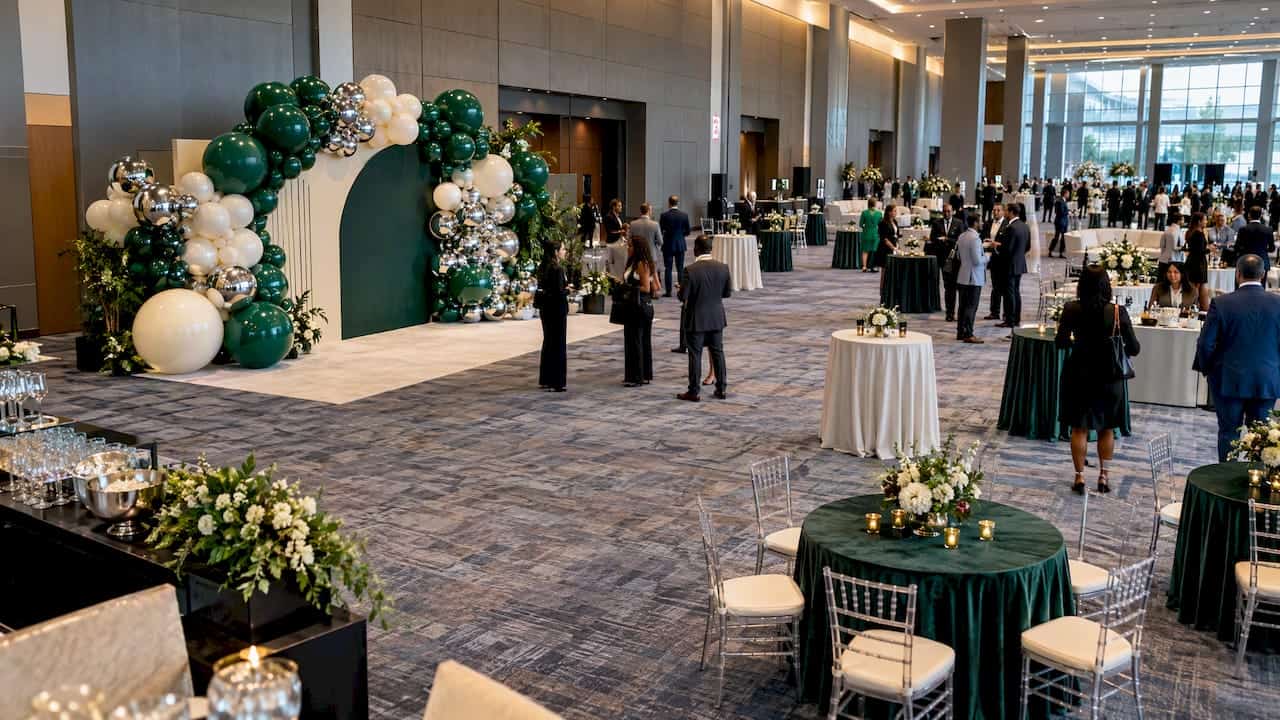
A balloon photo backdrop gives a conference a branded, camera-ready spot that attendees want to stand in front of. The best ones are sized for the crowd, built on a stable frame, lit softly, colored to match the brand and cleared with the venue before load-in. Below you will find the design options, the sizing math, the lighting rules, the venue checks and the timing, plus what a custom build costs in Atlanta.
TL;DR
- Pick the design for the job: a solid balloon wall for logos and sponsor names, an organic arch or garland for a softer, luxury look, and a spiral or stacked arch for entrances.
- Size to the crowd: a freestanding backdrop around 8 feet wide suits a single photo spot, and larger step-and-repeat layouts need much more floor space.
- Light it softly: face the wall toward diffused light, avoid backlighting and keep the queue out of the walkway.
- Clear the venue early: exit routes, fire rules, insurance paperwork and balloon disposal should be settled before install day.
- Atlanta pricing is public: our arches start at $600, with delivery, setup and strike down from $125 and digital mockups at $75 each.
Table of Contents
- Why a Balloon Backdrop Works at a Conference
- Balloon Backdrop Designs That Photograph Well
- Working Your Brand Colors, Logo and Message into the Design
- Size, Structure and Placement
- Lighting and the Photo Area
- What to Check with the Venue Before Installing
- Timing: When to Design, Deliver and Install
- Our Perspective: Treat the Backdrop as a Brand Asset
- What a Conference Backdrop Costs in Atlanta
- Ready to Book a Conference Backdrop in Atlanta?
- FAQ
- Sources
Why a Balloon Backdrop Works at a Conference
Conferences are crowded with screens, banners and lanyards. A sculpted balloon installation is one of the few things in the room with real volume, color and texture, and that is exactly why attendees stop for it. It signals a moment worth photographing, and it gives your brand a place to live in every picture that gets shared afterward.
The photo opportunity also solves a practical problem. Attendees who cluster for selfies in the middle of a hallway block traffic. A defined backdrop gives them a destination, moves the crowd out of the main flow and puts your logo behind every face.
That is the idea behind the photo wall format. If you want the fundamentals first, our planner’s guide explains what a balloon photo wall is, and our overview of balloon backdrop design ideas and setup tips covers the basics of the build. This article stays focused on the conference setting: big rooms, tight schedules, brand standards and venue rules.
Balloon Backdrop Designs That Photograph Well
Not every balloon shape suits a conference. The right choice depends on whether the backdrop is there to carry a logo, frame a person or simply set a mood.
Solid balloon wall
A grid of uniform balloons creates a clean, dense surface. It is the strongest choice when you want a logo, hashtag or sponsor name displayed across the middle, because the flat surface holds a sign, a vinyl graphic or a custom-cut shape. It reads as polished and formal, which suits keynote lobbies and executive receptions.
Organic balloon arch or garland
Organic designs mix balloon sizes, often from small 5-inch balloons up to large 18-inch ones, so the installation has depth and an irregular, sculptural edge. It is the look people picture when they think of luxury balloon styling. Placed around a screen, signboard or doorway, it frames a photo without hiding your message. Our organic balloon arch planning guide walks through that process step by step.
Spiral and stacked arches
Spiral and stacked arches have a more architectural line. They work well over an entrance, across a registration area or as a walk-through photo moment. If you are comparing shapes, our guide to types of balloon arch designs lays out the options side by side.
Balloon wall with marquee letters or a sign
Big letters spelling a conference acronym, a year or a short word like “JOIN” turn a backdrop into a branded prop. They also make a photo instantly recognizable on social media. We build oversized balloon letters from $50 per letter, and LED marquee letters can add glow for evening receptions.
Choosing between them
| Goal | Best fit | Why |
|---|---|---|
| Logo or sponsor names must be legible | Solid wall with a mounted sign | Flat surface, clean contrast |
| Luxury, editorial feel | Organic arch or garland around a frame | Depth, mixed sizes, sculptural edge |
| Entrance or walk-through moment | Spiral or stacked arch | Strong silhouette from a distance |
| Acronym or theme word | Oversized balloon or LED marquee letters | Instantly shareable |
| Multiple sponsors | Segmented wall with separate color blocks | Each brand gets its own zone |
A dedicated photo installation can also multiply the posts attendees create. One event-industry source observes a 3 to 5 times lift in attendee social posts with balloon photo displays, though that is one company’s observation and your own results will depend on placement, lighting and how well the spot is promoted on signage.
Working Your Brand Colors, Logo and Message into the Design
Brand teams are often surprised that balloon colors cannot be matched like paint. Latex comes in a fixed range of manufacturer colors, and the finish (matte, pearl, chrome, metallic) changes how a shade reads. Venue lighting shifts it again. The practical approach is to match the brand palette closely and make the exact brand color appear where it is printed, on the sign, vinyl or backdrop panel.
Here is what to send your decorator:
- Logo files in vector format, such as an EPS or SVG, plus a PNG.
- Color values: Pantone references first, then CMYK or hex codes.
- Brand guidelines covering clear space and any colors that must not sit next to each other.
- The exact wording for signage, hashtags and sponsor lines.
- A photo of the room or the floor plan so the design can be scaled to the space.
Balloon colors that are related to a brand shade rather than identical are normal. A navy corporate blue might be built from a deep navy, a slate and a silver chrome so it photographs as rich and dimensional rather than flat. We have a full breakdown in six palettes that match brand hex codes.
A digital mockup is the fastest way to settle the debate before anything is inflated. Ours is $75 per mockup, so your marketing team and the venue contact can approve the look on screen. Details are on our digital mockup page.
Size, Structure and Placement
Start with the room, not the design. Measure the width, depth and ceiling height of the spot you want, then match the backdrop to the crowd and the purpose.
Planning guides in the backdrop trade commonly treat an 8-by-8-foot wall as a standard photo booth size, and a taller, wider format around 8 by 10 feet as a conference favorite. Step-and-repeat style layouts can run from 10 by 10 feet to 20 feet wide, and they need considerably more floor space to photograph well. Treat these as starting points, because your ceiling height and traffic flow decide the final answer.
Some rules of thumb we use when planning:
- Leave room for the photographer. A guest needs space to step back and a phone needs distance to capture the whole frame. Several feet of clear floor in front of the backdrop is the minimum.
- Plan a queue. A popular backdrop draws a line. Put it where the line can form without blocking a doorway, a registration desk or a session entrance.
- Use a freestanding frame. A metal frame keeps the installation stable and avoids attaching anything to walls, which many venues forbid.
- Think about sight lines. A backdrop should not hide signage, sponsor booths or the path to the nearest exit.
- Account for ceilings and fixtures. Sprinkler heads, hanging banners and low chandeliers all limit height. Our guide to balloon chandelier installation for Atlanta events explains how those restrictions play out.
If the backdrop is outside, such as on a hotel terrace or a plaza at a convention center, wind becomes a design factor. Weighted bases and UV-resistant balloons are standard precautions, and a sheltered location is better than a wide-open one.
Lighting and the Photo Area
A beautiful backdrop can look flat in a photo if the lighting is wrong. The fixes are inexpensive and should be decided during the design, not on install day.
- Face the wall toward soft, diffused light. Avoid placing it in front of a window or bright stage, because backlighting turns attendees into silhouettes.
- Use natural light where you can. Otherwise, softbox lighting or string lights work well, and harsh overhead lighting should be avoided, as event venue guidance on photo walls recommends.
- Add warm accents for evening events. Fairy lights or LED marquee letters add sparkle without glare.
- Watch glossy surfaces. An AV production team notes that matte finishes photograph best under stage lighting, since glossy materials can reflect light. Chrome and high-shine balloons look stunning in person, so we use them as accents against matte or pearl bases rather than across the whole surface.
- Keep the area uncluttered. A clean floor, a small sign with the hashtag and a neutral wall behind the installation keep the focus on the balloons and your guests.
If an attendee photographs a backdrop and the brand is hard to read, the investment is wasted. We always check legibility from a phone-distance viewpoint before we call a design finished.
What to Check with the Venue Before Installing
Balloon installations are usually welcome, but every venue has rules about what comes through the door. Ask these questions early, ideally while you are still negotiating the venue contract.
Exit routes and accessibility
A backdrop must never narrow or hide a path of escape. Under OSHA’s rule for exit routes, 29 CFR 1910.37, exit routes must stay unobstructed and the line of sight to exit signs must remain clear. Place the installation and its queue away from those paths.
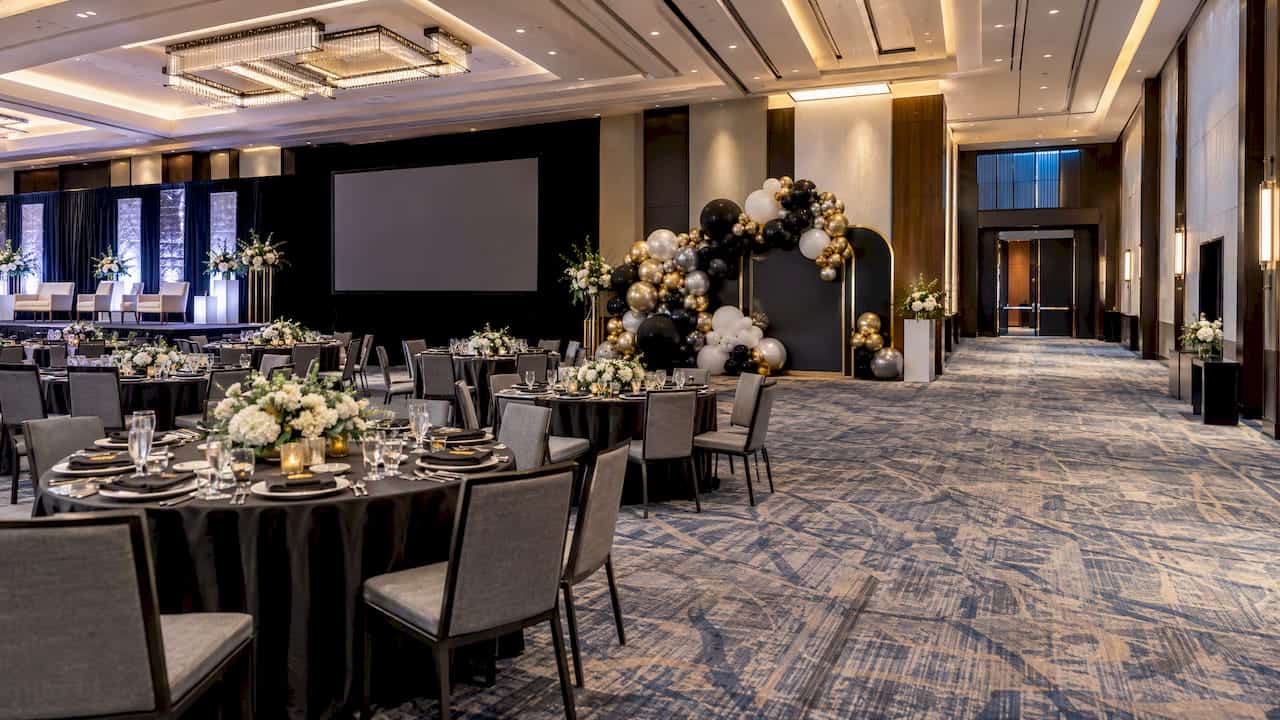
Accessibility matters too. The ADA design standards set a minimum clear width of 36 inches for an accessible route, as stated in the ADA Standards for Accessible Design. A photo line should never squeeze the walkway below that.
Fire rules
In Georgia, the state minimum fire safety standards say combustible decorations, curtains and similar materials in assembly occupancies must meet the International Fire Code provisions, and authorities can impose extra controls on the quantity and arrangement of combustible contents. The text is in the Georgia state minimum fire safety rules. Ask the venue whether it has a flame-retardant requirement for decorations, and do not place candles or open flame near balloon installations. Open flame is restricted in assembly spaces by that same rule, so check before adding candle-style effects. Flameless candles or LED lighting give the same glow.
Insurance, access and disposal
Corporate venues frequently ask outside contractors for a certificate of insurance, and some require it before they confirm the booking. Ask for the venue’s exact wording and the entity it must name, then pass that to your decorator early. Also ask about:
- loading dock hours and elevator access
- whether helium is allowed
- floor protection or rigging limits
- wall and ceiling attachment rules
- who handles trash and balloon disposal
Venues expect the space to be left clean and free of balloon debris, so confirm the strike plan in writing. We have written separately on five questions planners must ask about balloon decor venue restrictions and on venue coordination for balloon decor, and both are worth a read before you send your first email to the venue.
Large convention centers may also require formal event paperwork. One example is Puerto Rico’s convention center, which asks for an operations plan 30 days ahead, according to its event planning guide. Atlanta venues have their own deadlines, so request the exhibitor or vendor manual as soon as you sign.
Timing: When to Design, Deliver and Install
A conference backdrop is not a last-week purchase. As a general planning pattern, installation windows are booked days to weeks ahead, with larger brand activations needing more lead time than a single photo wall. We recommend working backward from your event date:
- Eight to six weeks out: confirm the concept, size and placement, and ask the venue for its rules.
- Six to four weeks out: send logo files and color values, approve the digital mockup and request the insurance certificate.
- Three weeks out: finalize signage text, power needs for any LED elements and the exact install window.
- Install day: arrive in the agreed window, build, light-check and photograph the finished piece.
- After the event: strike, remove all balloon debris and return the space as found.
The install window is the part planners most often underestimate. Loading docks are shared, freight elevators are scheduled and other vendors compete for the same hours. Another vendor type with the same constraints is live music, and this explanation of load-in window space requirements shows how much a delay in access can cost a timeline. Build a buffer so a late dock slot does not squeeze your install into the final hour before doors open.
For balloons, the build happens close to the event so they look fresh. If your event is outdoors or in a hot room, ask your decorator how they manage that.
Our Perspective: Treat the Backdrop as a Brand Asset
We design conference installations all the time, and the pattern is consistent. The backdrops that perform are the ones planned like any other brand asset: a clear purpose, a measured space, a color plan that has been seen on screen and a place in the attendee journey.
Here is what we tell corporate planners in Atlanta and across the surrounding communities, from Marietta and Smyrna to Alpharetta, Decatur and Peachtree City:
- Decide what the photo is for. If you want logo visibility, build a wall. If you want an emotional first impression, build an arch or garland.
- Put it where people already walk. A backdrop at the end of a dead-end corridor stays empty.
- Mix finishes. Matte and pearl balloons give the base, and metallic or chrome gives the sparkle. It keeps the piece luxurious in person and clean on camera.
- Do not skip the mockup. Seeing the design before it is built saves time and revision rounds.
- Plan the strike. A great install that leaves a mess makes the venue less likely to welcome the next decorator, so we clean up as carefully as we build.
Our team treats a balloon backdrop as more than decoration. It is a piece of event architecture that holds your logo, guides your guests and creates the photo they will post tonight.
— Kay
What a Conference Backdrop Costs in Atlanta
We publish starting prices so planners can budget without waiting for a quote. Final pricing depends on size, design complexity, colors and location, and these are “from” prices as listed on our balloon decor pricing page.
| Item | Starting price |
|---|---|
| Spiral balloon arch | from $600 |
| 24 ft stacked arch | from $600 |
| Organic balloon arch | from $700 |
| Luxury organic balloon arch | from $1,000 |
| Big letters | from $50 per letter |
| Delivery, setup and strike down | from $125 |
| Digital mockup | $75 per mockup |
| Site visit | $250 |
A site visit is worth the $250 for a large or unusual venue. We see the ceiling, the load-in route and the lighting in person, which prevents surprises. Custom conference installations with branded elements, multiple sponsor zones or LED marquee letters are quoted individually.
Ready to Book a Conference Backdrop in Atlanta?
If your conference, trade show or brand activation is coming up in the Atlanta area, we can take it from concept to strike: design, mockup, venue coordination, delivery, install and cleanup. Our corporate event team builds balloon backdrops and photo booths for companies, agencies, hotels and convention centers within about 60 miles of Atlanta.
Start with our corporate and event services and send us your date, venue and brand colors. For design inspiration, browse the balloon decor gallery, or see how corporate event balloon decor ideas have turned ordinary rooms into branded experiences. You can also reach our studio at 135 Riverside Parkway, Austell, GA 30168 or call 678.203.0200. Book now and let us make your backdrop the most photographed spot in the building!
FAQ
How big should a conference photo backdrop be?
For a single photo spot, a backdrop about 8 feet wide and 8 to 10 feet tall is a common conference size. Larger step-and-repeat layouts can reach 20 feet wide but need much more floor space. Measure the venue’s width, depth and ceiling height first, then add room for the photographer and a queue.
Can a balloon backdrop match our brand colors exactly?
Not always. Balloon colors come in fixed manufacturer shades, and finish and lighting change how they look. We match your Pantone, CMYK or hex values as closely as possible, then put exact brand colors on printed signage or panels. A digital mockup shows you the result before the build.
Will the venue allow balloons?
Usually, but each venue has its own rules about attachments, helium, flame-retardant materials, insurance and disposal. Ask for the vendor guidelines early, and keep exit routes and exit signs clear. Our venue restrictions guide lists the questions to ask.
How far ahead should we book?
Book as soon as the venue and date are confirmed, ideally six to eight weeks ahead for a custom design, and earlier for large brand activations. That leaves time for a mockup, insurance paperwork and a reliable install window.
Sources
- OSHA 29 CFR 1910.37, exit routes
- ADA Standards for Accessible Design
- Georgia state minimum fire safety standards
- Puerto Rico Convention Center event planning guide
- Instagram wall ideas guide
- Conference stage design ideas