Luxury hotel ballroom balloon decor is best handled by commissioning a full-service designer who manages the organic arches, garlands, backdrops, and immersive installations from concept through strike. That means the designer coordinates venue approvals and production alongside your banquet team, not just delivering balloons on the day. Your immediate next step: request a site visit and a digital mockup so you can see the design against your actual ballroom before signing anything.
TL;DR:
- Proper planning with a full-service designer ensures room safety requirements, rigging points, and load-in windows are addressed early to prevent costly modifications or delays.
- Using high-quality latex, a unified color scheme, and sophisticated finishes elevates the decor’s perceived value and aligns with an upscale aesthetic.
- Detailed venue information, including ceiling heights, fire safety regulations, and approved rigging points, is essential before finalizing the design to avoid compliance issues.
- Booking a designer four to twelve months in advance, especially for large immersive setups, secures better scheduling and allows proper coordination with venue rules.
- Conducting site visits and requesting digital mockups beforehand reduces the risk of surprises during installation and streamlines the approval process.
Table of Contents
- What Luxury Hotel Ballroom Balloon Decor Includes
- What Venue Details Do You Need Before Finalizing a Design?
- How to Commission a Ballroom Balloon Installation Step by Step
- How Long Does It Take and What Drives the Cost?
- Why Hire a Luxury Balloon Designer for This Kind of Event
- What Goes Wrong During Ballroom Setup and How to Prevent It
- How to Choose a Balloon Vendor Experienced With Hotel Ballrooms
- What Questions Should You Ask a Balloon Decor Provider?
- Red Flags to Watch for When Vetting Providers
- The Real Gap in Most Ballroom Balloon Advice
- Book a Site Visit or Request a Digital Mockup
- Sources
- FAQ
What Luxury Hotel Ballroom Balloon Decor Includes
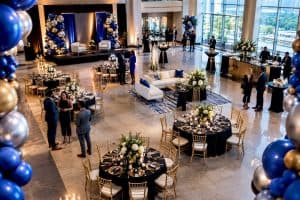
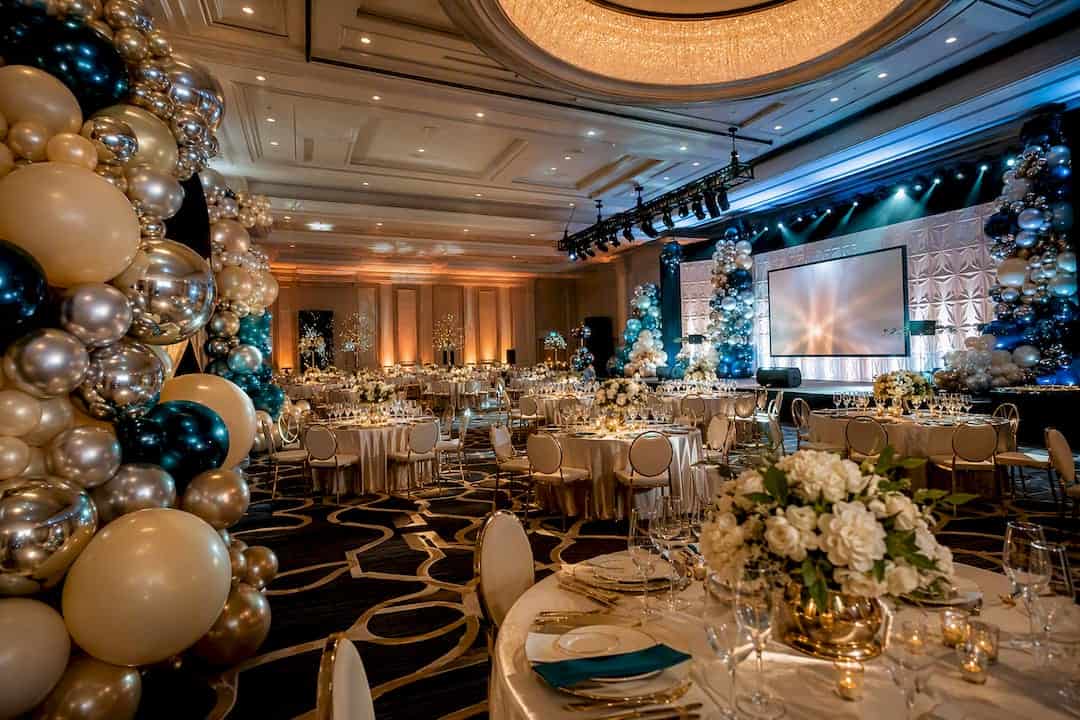
A ballroom-scale installation is really a family of design elements, each solving a different problem in the room. Organic balloon arches and garlands frame entrances, staircases, and stage openings with clusters of varying balloon sizes for movement and depth. Spirals and columns work as wayfinding markers along a gala’s cocktail-to-dinner transition or flanking a step-and-repeat. Freestanding immersive installations, oversized floral-balloon trees or sculptural centerpieces, anchor a room’s focal point, whether that’s a stage backdrop or a sponsor activation wall.
Balloon backdrops and photo ops deserve their own placement logic. They perform best near natural traffic pauses (registration, bars, exits) where guests already stop to wait. Marquee letters spelling a company name, milestone year, or monogram give corporate events and galas an instantly shareable focal point. Integrated tablescapes, balloon centerpieces paired with candles, linens, and florals, tie the room together at eye level, where guests actually spend their evening.
Placement should follow function:
- Arrival points get scale and color impact to set tone the moment guests walk in
- Stage framing uses columns or arches sized to television and photography sightlines
- Sponsor or brand zones use marquee letters and backdrops positioned for visibility, not just decoration
- VIP and photo areas get the most detailed, camera-ready finishes
For a genuinely upscale look, finish matters as much as shape. High-quality latex with a true chrome or metallic sheen, layered with complementary florals, reads dramatically more expensive than mixed-quality balloons in a scattershot palette. A unified color story across arches, centerpieces, and backdrops is what separates a ballroom that looks styled from one that looks assembled.
What Venue Details Do You Need Before Finalizing a Design?
No ballroom design should be locked before the venue’s own rules are on paper. Hotel ballrooms are private facilities, but most follow the same safety logic that governs convention and meeting spaces: clearances, materials, and access routes are non-negotiable, not creative suggestions.
Ask the hotel’s banquet or engineering team for these specifics before finalizing anything:
- Ceiling height throughout the room, including any lower sections near chandeliers or beams
- Exact sprinkler head and smoke detector locations, since installations can’t obstruct either
- Locations of visible fire equipment, extinguishers, pull stations, exit signage, that must stay unobscured
- Aisle widths and any canopy or overhead clearance minimums near walkways
- Approved rigging points for hanging elements, and whether the hotel allows attachment to fixtures at all
- Load-in and strike windows, since ballrooms often turn over multiple events in a single day
Convention-industry guidance from the International Association of Exhibitions and Events notes that facilities may regulate canopies, ceiling clearances, flame-retardant materials, and access routes, and hotel ballrooms generally apply comparable logic even without a formal exhibitor manual.
Pro Tip: Ask specifically whether the hotel requires flame-retardant certification for hanging decor. Some properties request a certificate on file before your install team ever arrives, and finding that out on load-in day is the fastest way to lose your window.
Your main point of contact is usually the banquet or catering manager, but for larger galas you’ll also want the hotel’s engineering or facilities lead and, where one exists, the official service contractor overseeing rigging and utilities. Ask for the venue’s exhibitor or vendor manual even for a “simple” ballroom event. It usually answers half these questions before you make a single phone call.
How to Commission a Ballroom Balloon Installation Step by Step
Treat this as a sequence, not a single conversation. Skipping steps is how planners end up with a beautiful mockup that the fire marshal won’t approve.
- Site visit and measurements. A designer walks the room, checks ceiling heights, notes rigging points, and photographs sightlines from the entrance and head table.
- Creative brief and palette. You define the event’s tone, brand colors, and any must-have moments (photo wall, stage arch, sponsor visibility).
- Scaled floor plan and mockup. The designer produces a to-scale layout and a digital rendering so you can see proportions against the actual room, not a stock photo.
- Venue safety review and approvals. The hotel signs off on materials, clearances, and attachment methods before production begins.
- Quote and contract. Pricing reflects the confirmed design, labor, and any hotel service fees.
- Production schedule. Balloons are built and staged in the days leading up to the event, timed to the venue’s actual load-in window.
- Controlled load-in and install. The team works within the hotel’s approved hours, often coordinating around other vendors.
- On-site inspection and event-day support. A final walkthrough confirms everything holds and looks right under the room’s actual lighting.
- Strike. Balloons and hardware are removed promptly so the ballroom can turn over for its next booking.
Before requesting a quote, have these ready: a floor plan, final or estimated guest count, stage and dance floor dimensions, power locations, brand guidelines or color references, sample images of styles you like, and your desired photo op locations. The more specific your brief, the more accurate your first quote will be.
If the hotel requires an approved or exclusive official service contractor for rigging or utilities, that changes both your schedule and your cost, since your balloon team may need to work under OSC labor rules rather than installing independently. Bringing your balloon designer in during step one, alongside your venue booking, avoids discovering that constraint two weeks before the event. A venue coordination checklist built for this exact handoff is worth building into your RFP process.
How Long Does It Take and What Drives the Cost?
Timeline depends heavily on scale. Freeman’s production guidance suggests a small corporate meeting can sometimes be planned in a matter of weeks, while large-scale immersive productions often need lead times stretching many months, occasionally over a year, once creative development, AV integration, and vendor scheduling are factored in. A ballroom gala with a marquee installation and integrated lighting sits somewhere between those two extremes, and four to twelve months of lead time is a reasonable planning window for anything beyond a straightforward arch.
Several factors drive what you’ll pay:
- Labor, rigging, and OSC fees, especially when a venue requires approved contractors for hanging or utilities
- Venue service charges, which vary by property and can include facility fees for load-in access or overnight security
- Specialty finishes, chrome, integrated florals, or custom color-matching, cost more than standard latex
- AV and lighting integration, since coordinating your installation with a lighting designer takes extra planning time
- Delivery, setup, and strike labor, which scales with room size and installation complexity
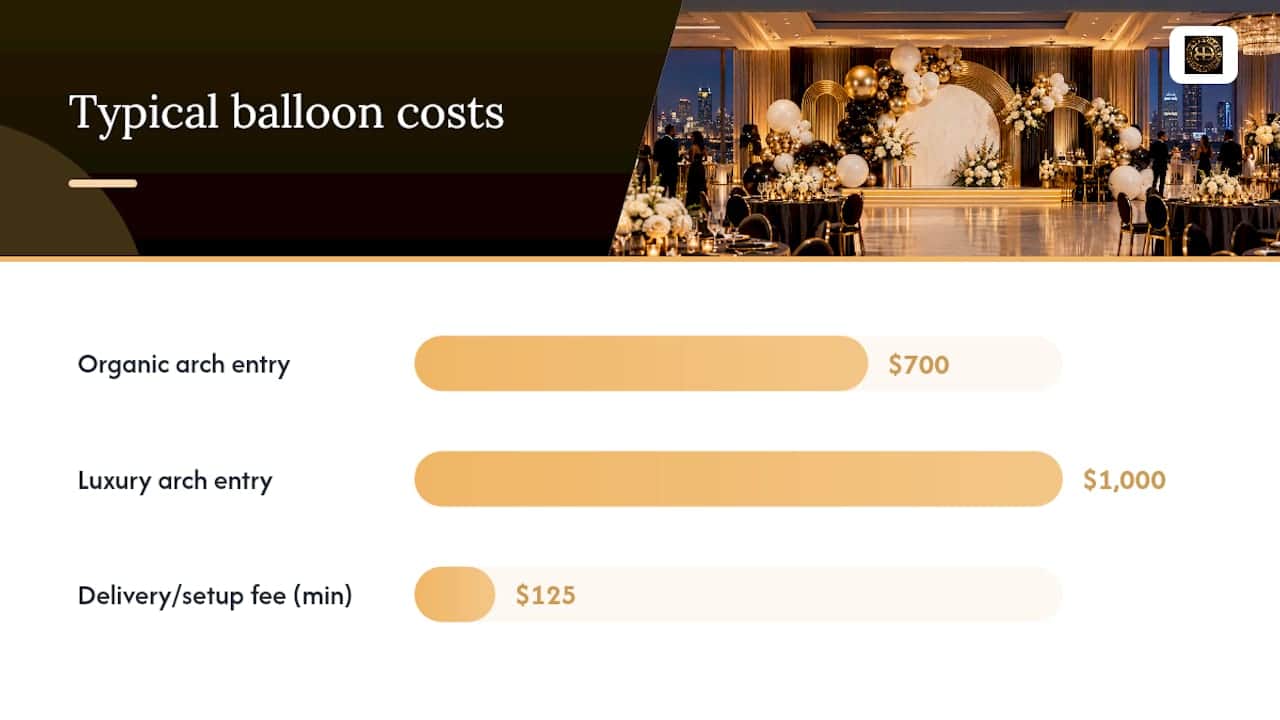
Publicly listed organic balloon arch pricing starts at $700, with luxury organic arches starting at $1,000 and delivery, setup, and strike fees starting at $125. Ballroom-scale immersive designs typically run above these entry points once labor and finishes are added.
To avoid overtime charges or last-minute scrambling, build in a staggered load-in schedule, protect your mockup from other vendors’ setup activity, and leave a buffer window between install completion and doors-open. That cushion is what saves a gala when the loading dock runs behind schedule, which happens more often than any contract wants to admit.
Why Hire a Luxury Balloon Designer for This Kind of Event
Ballroom-scale installations reward experience you can’t fake with enthusiasm alone. Kay, creative event stylist and luxury balloon artist at Atlanta Balloon Designer LLC, an award-winning studio based in Austell, Georgia, has led design work for corporate clients and high-profile events where the ballroom itself needed to function as a brand statement, not just a backdrop.
Services that map directly onto ballroom needs include:
- Organic balloon arches for entrances and stage framing
- 24 ft stacked arches for statement walls and large-scale focal points
- Freestanding immersive installations built around a room’s specific dimensions
- Digital mockup services so stakeholders approve the design before production
- Site visits to confirm rigging points and clearances in person
- Full production, delivery, setup, and strike handled end to end
Planners working with hotels across Atlanta and the surrounding metro have used this exact sequence, site visit, mockup, approval, production, to turn a generic ballroom into something guests photograph on arrival. If you want to see the range of what’s possible before you brief your own event, the gallery of completed installations is a useful reference point to bring into your first vendor conversation.
What Goes Wrong During Ballroom Setup and How to Prevent It
Most ballroom balloon problems trace back to timing, not design. Hotels often book back-to-back events in the same space, which means your load-in window might be four hours instead of the full day you assumed. Confirm the exact window in writing during your site visit, not the week of the event.
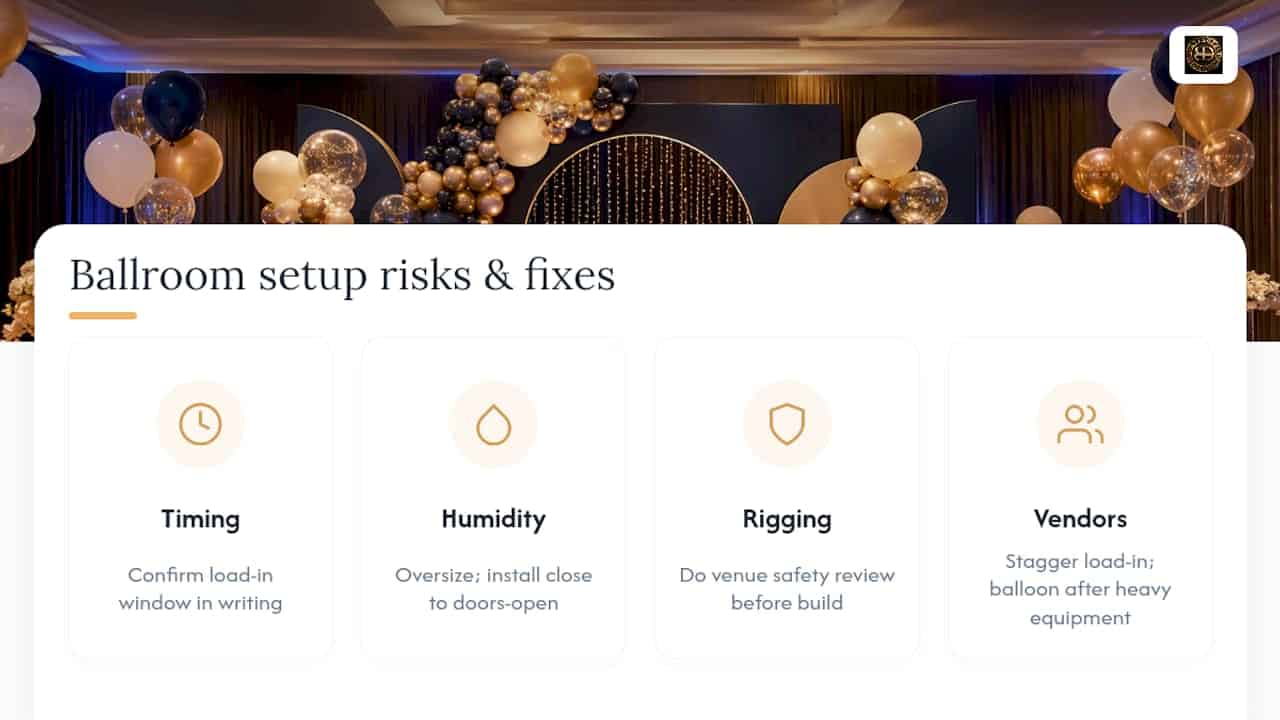
Humidity and HVAC swings are the second most common issue. Ballrooms with aggressive air conditioning or a kitchen adjacent to the room can shrink latex faster than expected, especially over multi-hour events. A designer who has worked that specific property before will know to build in slight oversizing or schedule install closer to doors-open.
Rigging conflicts come up when a hotel restricts what can attach to ceiling fixtures or chandeliers. This is exactly why the venue safety review has to happen before production, not after. Finding out an approved rigging point doesn’t exist where your design assumed one does is expensive to fix mid-build.
Finally, multi-vendor traffic, AV crews, florists, catering staff, all working the same room at once, can damage an installation that goes up too early. Staggering load-in so balloon work happens after heavy equipment moves but before final linen and place-setting reduces the risk of a bumped arch or a scuffed backdrop right before doors open.
How to Choose a Balloon Vendor Experienced With Hotel Ballrooms
Ask for ballroom-specific portfolio examples, not just general event photos. A vendor who has only styled backyard parties may not know how to work around a hotel’s rigging restrictions or negotiate load-in time with a banquet manager who has three other events that day.
Confirm they’re comfortable producing a scaled floor plan and a digital mockup before production starts. This single deliverable separates vendors who plan from vendors who improvise on-site, and improvising in a ballroom booked to the minute is a real liability.
Ask how they handle venue coordination directly. A designer who has previously communicated with hotel engineering teams about clearances and rigging points will move faster through approvals than one encountering that process for the first time on your event.
Check whether they carry insurance appropriate for hotel work and whether they’re prepared to follow OSC or exclusive-contractor rules if the venue requires them. This is often where inexperienced vendors stumble, not because their design work is weak, but because they didn’t know the rule existed.
What Questions Should You Ask a Balloon Decor Provider?
A short, direct list during your first call tells you almost everything you need to know:
- “Have you installed in this specific ballroom or hotel before?”
- “Can you provide a scaled floor plan and a digital mockup before we sign a contract?”
- “How do you handle the hotel’s fire and rigging approval process?”
- “What’s included in your delivery, setup, and strike fee, and what triggers an additional charge?”
- “What happens if the venue’s load-in window changes at the last minute?”
- “Do you carry liability insurance, and can you provide documentation to the hotel?”
Vendors who answer these quickly and specifically, rather than vaguely, are usually the ones who’ve actually done this work at scale.
Red Flags to Watch for When Vetting Providers
Walk away, or at least slow down, if a vendor refuses to visit the venue in person before quoting a ballroom-scale project. Pricing a large installation from photos alone almost guarantees surprises on install day.
Be cautious of anyone who can’t explain how they’d handle a venue’s fire marshal or rigging requirements. If they seem unfamiliar with terms like clearance or approved contractor, that’s a sign they haven’t worked a formal venue before.
A vendor unwilling to provide a written contract detailing load-in times, strike responsibilities, and additional fees is asking you to take on risk that should be theirs. And if a provider can’t show you any prior ballroom or hotel event work, treat that gap as information, not an oversight.
The Real Gap in Most Ballroom Balloon Advice
Most guidance on hotel ballroom decor treats balloons as a standalone spectacle, pick a color, pick an arch, done, missing how decor supports broader attendee experience and venue considerations as highlighted in the role of food in hospitality. That framing misses what actually separates a forgettable room from a memorable one. Event-design principles from organizations like MPI treat decor as one input into the guest’s overall experience, tied to flow, programming, and objectives, not an isolated vendor line item.
That’s the shift planners should make first: decide what you want guests to feel or do at each point in the room, arrival, dinner, stage moment, before you decide what the balloons look like. Freeman’s research on immersive design backs this up directly. Installations that support attendee behavior, drawing eyes toward a stage, marking a photo moment, signaling sponsor presence, outperform decor chosen purely for visual impact.
The other underrated priority is sequencing. Planners who bring their balloon designer in during venue selection, not after the floor plan is locked, avoid the rigging surprises that derail otherwise perfect designs. Conventional advice focuses on style boards. The work that actually protects your event happens in the site visit and the safety review, weeks before anyone picks a ribbon color.
— Kay
Book a Site Visit or Request a Digital Mockup
Atlanta Balloon Designer is the alternative to piecing together a ballroom installation vendor by vendor. You get one accountable team handling design, venue coordination, production, and strike, instead of juggling separate contracts for arches, backdrops, and rigging.
If you’re planning a hotel ballroom event anywhere within the Atlanta metro, including Marietta, Roswell, Alpharetta, or Buckhead, the smartest first move is a site visit paired with a digital mockup so you can see the design against your actual room before committing budget. When you reach out, include your event date, venue name, guest count, rough budget range, and a floor plan if you have one. That information lets us turn around an accurate proposal instead of a generic estimate. Weekend load-in slots for large-scale ballroom installs book out fastest, so galas and corporate events planned four or more months ahead have the widest window to lock in production time. Review current pricing and packages or explore the full services overview to see what fits your event, then request your mockup to get the design conversation started.
Sources
- Guidelines for Display Rules and Regulations (IAEE)
- IAEE event operations (CEM resources)
- AV creative production: the key to transforming events (Freeman)
- MPI event-design education
FAQ
Does a hotel ballroom require a specific rigging approval for balloon installations?
Most hotels require confirmation of approved rigging points before hanging any decor, and some restrict attachment to chandeliers or ceiling fixtures entirely. Convention-industry standards from IAEE note that facilities may regulate clearances and flame-retardant materials, and hotel ballrooms typically apply similar logic even without a formal exhibitor manual.
How much does luxury balloon decor cost for a hotel ballroom event?
Pricing depends on scale and finish, but published balloon decor pricing starts organic arches at $700 and luxury organic arches at $1,000, with delivery, setup, and strike starting at $125. Ballroom-scale immersive installations with specialty finishes typically run above these starting points.
How far in advance should I book a balloon designer for a ballroom gala?
A straightforward arch or centerpiece package can sometimes be arranged in a few weeks, but large-scale immersive productions benefit from four to twelve months of lead time, particularly when AV or lighting integration is involved. Booking early also secures your preferred load-in window at the venue.
What should I ask for before requesting a formal quote?
Provide a floor plan, guest count, stage and dance floor dimensions, power locations, brand guidelines, and any reference images before requesting pricing. A digital mockup built from these details gives you a far more accurate proposal than a verbal estimate.
Does Atlanta Balloon Designer coordinate directly with hotel venue staff?
Yes. Site visits and venue coordination are part of the standard commissioning process, including confirming clearances, rigging points, and load-in windows with the hotel’s banquet or engineering team. That coordination happens before production begins, not after the design is finalized.