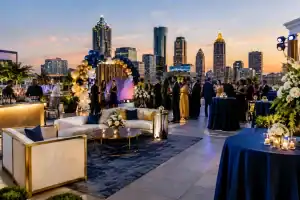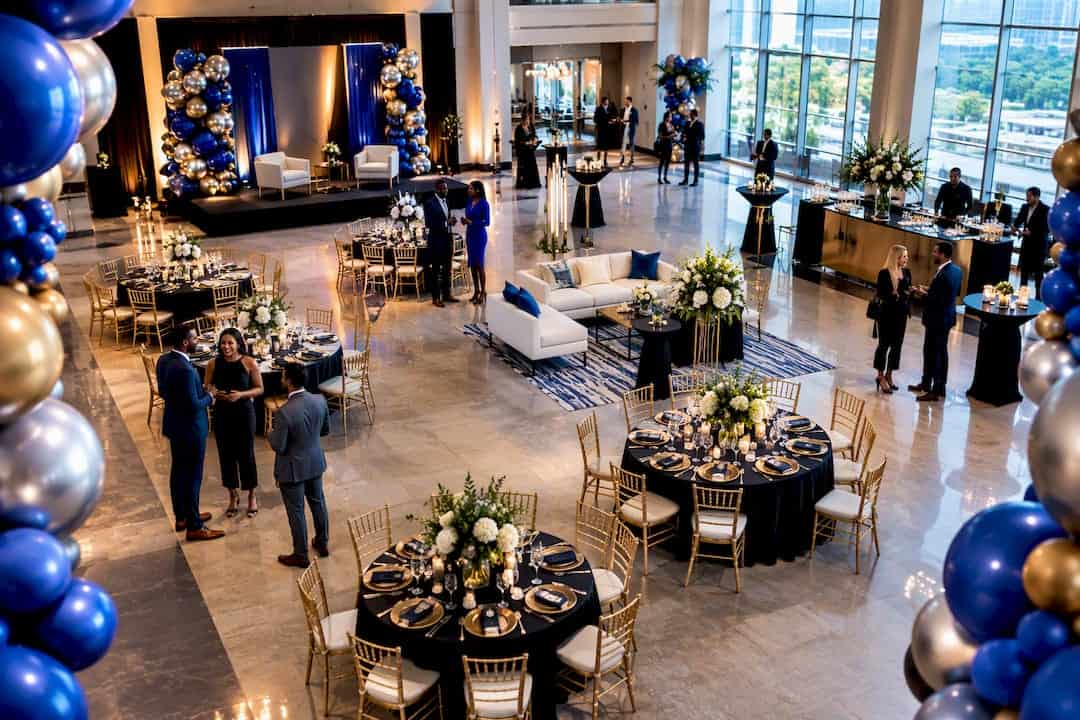
Most venues allow balloons, but almost every one of them attaches conditions that can quietly derail your design if you skip the paperwork. The single most important move you can make is requesting the venue’s written decor policy before you sketch a single arch. Until that policy is in hand, plan around freestanding, weighted installations rather than anything taped, hung, or tethered to the ceiling.
TL;DR:
- Most venues ban adhesives, require certified riggers for ceiling attachments, and restrict helium use near sprinklers and exits, often leading to covert policy violations.
- Clear written approval of decor policies, rigging plans, load-in logistics, and insurance requirements is essential to avoid damage fees and setup disputes.
- Freestanding balloon designs like weighted arches and modular backdrops are the safest compliant alternatives, capable of achieving dramatic effects without violating restrictions.
- Using improper load bases, neglecting to confirm safety limits, or assuming certain balloons are allowed can cause setup rejection or liability issues.
- Hiring experienced, insured installers who handle all compliance steps ensures smoother approval and a polished, safe event that meets venue specifications.
Table of Contents
- What Do Venue Balloon Decor Restrictions Actually Cover?
- Why Do Venues Impose Such Strict Balloon Rules?
- What Should You Ask the Venue Before Installation Day?
- What Are the Best Compliant Alternatives to Restricted Setups?
- What Mistakes Cause Rejected Setups or Damage Fees?
- How Much Weight Do Balloon Installations Actually Need?
- Are Certain Balloon Types Banned at Some Venues?
- Can You Use Open Flames or Heaters Near Balloon Decor?
- What Happens to Balloons After the Event?
- Atlanta Balloon Designer’s Perspective on Venue Compliance
- Let Atlanta Balloon Designer Handle Venue Approvals for You
- Sources
- FAQ
What Do Venue Balloon Decor Restrictions Actually Cover?
Venue balloon decoration guidelines almost always live in the same paragraph as their fire safety and property protection rules, and once you’ve read a handful of them, the pattern becomes obvious. These are the clauses that show up again and again in contracts and decor policy PDFs.
- No tape, glue, push pins, or Command hooks. Adhesives that seem harmless on drywall or event walls often peel paint or leave residue, and most venues ban them outright.
- Helium and loose balloons stay away from sprinklers, vents, and exits. Anything floating near a sprinkler head, HVAC vent, directional exit sign, or egress path is a fire-code red flag, not just an aesthetic one.
- Ceiling rigging is limited to approved points. Many venues require certified riggers or in-house staff to handle any attachment above head height, and freelancing your own hanging system is rarely an option.
- Confetti, glitter, open flame, and aerosol sprays are frequently prohibited. These cause slip hazards or lingering cleanup that housekeeping staff has to bill for.
- Helium tanks have their own handling rules. Venues often dictate where tanks can be stored, how they’re secured, and whether they’re allowed in public-facing areas at all.
A sample university decorations policy illustrates exactly this mix: no tape, no hanging from lighting fixtures, no glitter, and helium restricted in certain rooms, with cleanup fees reserved for violations. Read your venue’s contract for language that mirrors it, because it usually does.
Why Do Venues Impose Such Strict Balloon Rules?
Fire code compliance drives most of it. Sprinkler heads and exit paths cannot be obstructed or crowded, and the NFPA’s codes and standards are the reference point most venues and fire marshals point back to when a decor plan gets flagged.
Damage and liability are the other half of the equation. Shine sprays and adhesive hooks are a recurring cause of paint peeling and slippery floor residue, which is exactly why so many venues bill cleanup or repair fees after events that used them, per the same NFPA safety guidance. If a guest slips on spray residue or a rigging point fails and something falls, the venue absorbs that liability, not you.
That risk calculus is exactly why so many properties keep a preferred-vendor list. Working with an insured, experienced installer who carries a certificate of insurance (COI) and knows which materials won’t damage a ballroom floor is a lot cheaper for a venue than adjudicating a claim after the fact.
What Should You Ask the Venue Before Installation Day?
Get answers to these in writing, in this order, before you finalize any design, and be aware of what a venue’s room rental food minimum really means for your event.
- Request the written decor policy. Ask specifically about adhesives, hanging or rigging, helium, and cleanup fees. Vague verbal assurances from a sales coordinator do not hold up if the operations team disagrees on event day.
- Ask who signs off on ceiling attachments. Some venues require a certified rigger; others handle it entirely with in-house staff and won’t let outside vendors near the grid at all.
- Confirm load-in logistics. Door widths, freight elevator access, load-in and strike windows, and power outlets for inflation equipment all need confirming, a step planner-facing delivery guides flag as a common source of last-minute scrambling.
- Get vendor insurance requirements in writing. Ask for the exact COI amount and any endorsements the venue’s risk management team requires.
- Document every exception in an email or contract addendum. If the coordinator verbally approves something outside the standard policy, get it confirmed in writing before you build around it.
Pro Tip: Email your venue contact a bulleted recap of every verbal approval within 24 hours and ask them to reply “confirmed.” That single habit resolves more day-of disputes than any other step on this list.
Planners who want a ready-made version of this process can start from our venue coordination guide, which walks through the same questions in a format you can hand straight to a coordinator.
What Are the Best Compliant Alternatives to Restricted Setups?
Freestanding designs deliver most of the visual drama without touching a wall, ceiling, or sprinkler line, and they’re the default recommendation whenever a venue’s policy is unclear or strict.
- Weighted balloon arches and columns. Properly ballasted bases (sandbags or fillable weights sized to the structure) let an arch stand on its own with floor protection underneath to prevent scuffs.
- Modular photo-backdrop frames. Freestanding frame systems create a full backdrop wall without a single hook or nail in venue property.
- Low-profile helium clusters, tethered below sprinkler height. Weighted anchors keep clusters well clear of vents and sprinkler heads while still adding lift and movement to a room.
- Certified rigging when ceiling height is the whole point. If a chandelier-style installation is non-negotiable for the design, bring in a certified rigger and get it in the written approval before build day, not after.
- Non-release alternatives for send-offs. Bubbles, planted giveaways, or a ribbon toss replicate the celebratory moment of a balloon release without the environmental or regulatory baggage.
Pro Tip: A well-ballasted organic arch photographs almost identically to a suspended one in most venue lighting, so don’t assume “freestanding” means “smaller impact.” Well-designed freestanding frames with proper ballast and floor protection can replicate much of the visual impact of a suspended piece without violating a no-attachment policy. If your event calls for a dramatic overhead moment, our balloon chandelier installation guide covers how to work with venue rigging requirements instead of around them.
What Mistakes Cause Rejected Setups or Damage Fees?
The same handful of errors account for most of the disputes we see between planners and venues.
- Assuming Command hooks count as “no damage.” Most venue policies ban them by name specifically because they don’t count as damage free.
- Skipping vendor insurance. Showing up without the COI amount or endorsements the venue requires can get an install turned away at the door.
- Underestimating load-in and strike windows. A rushed setup leads to shortcuts, and shortcuts are exactly what triggers policy violations.
- Using shine sprays or adhesives that leave residue. These are consistently named as the cause of paint and floor damage charges.
- Never confirming who handles teardown. Cleanup responsibility and timing need a name attached to them before the event, not during strike.
Skipping site visits and rigging plans is a common thread behind these mistakes, and it’s exactly why DIY balloon installs tend to leave planners deflated when a venue’s rules get enforced on the day of the event.
How Much Weight Do Balloon Installations Actually Need?
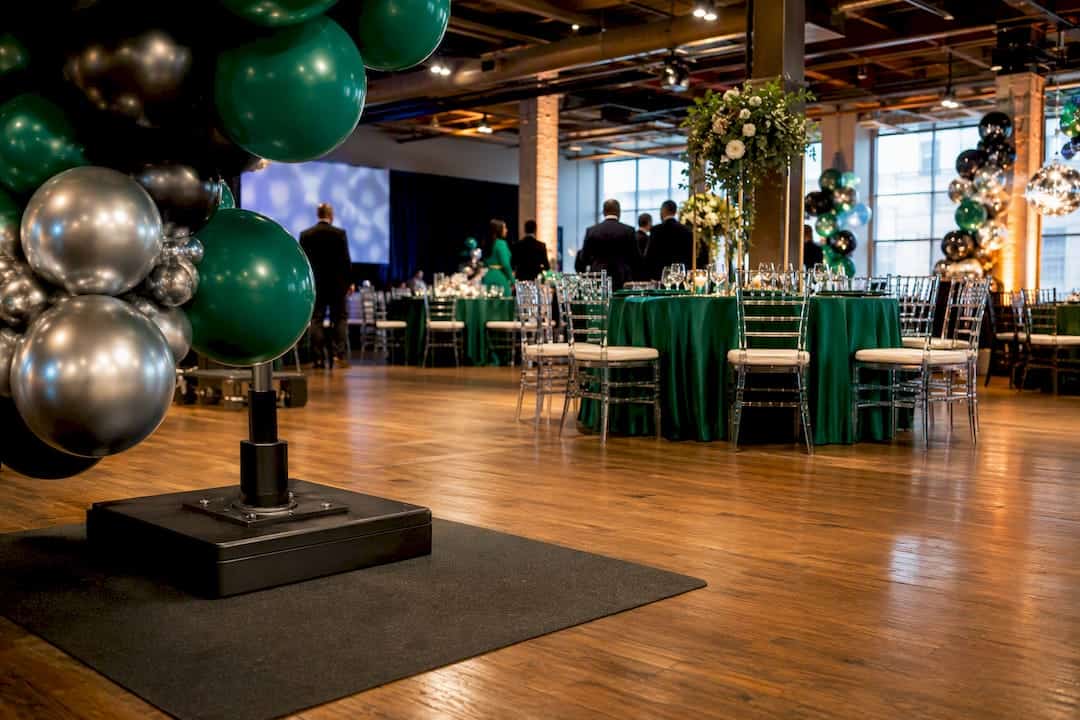
Weight is where most homemade balloon structures fail, and it’s rarely about the balloons themselves. It’s the base. An organic arch built with standard latex balloons needs a base heavy enough to resist wind from HVAC vents, foot traffic, and the natural pull of a curved structure trying to straighten itself out. Fillable weights, sandbags, or water-filled bases sized to the arch’s height and balloon density are the standard approach, and undersized bases are the number one reason arches tip mid-event.
Floor protection matters just as much as the weight itself. A heavy base sitting directly on hardwood or marble can scuff, dent, or leave impressions that show up on the venue’s post-event walkthrough, so a rubber or felt pad under every weighted point is worth the extra five minutes of setup. For hanging elements like garlands draped over a mantle or railing, the weight consideration shifts to load-bearing capacity: a garland heavier than the fixture can support will sag, twist the mounting point, or pull the fixture loose entirely.
Venues rarely publish specific numeric weight limits, but their decor policies typically address it indirectly through language about “no load on fixtures not rated for decor” or “freestanding installations only in specified areas.” When in doubt, ask the venue coordinator directly what load their railings, mantels, or archways are rated to hold, and design the base weight to exceed the structure’s tipping point by a comfortable margin.
Are Certain Balloon Types Banned at Some Venues?
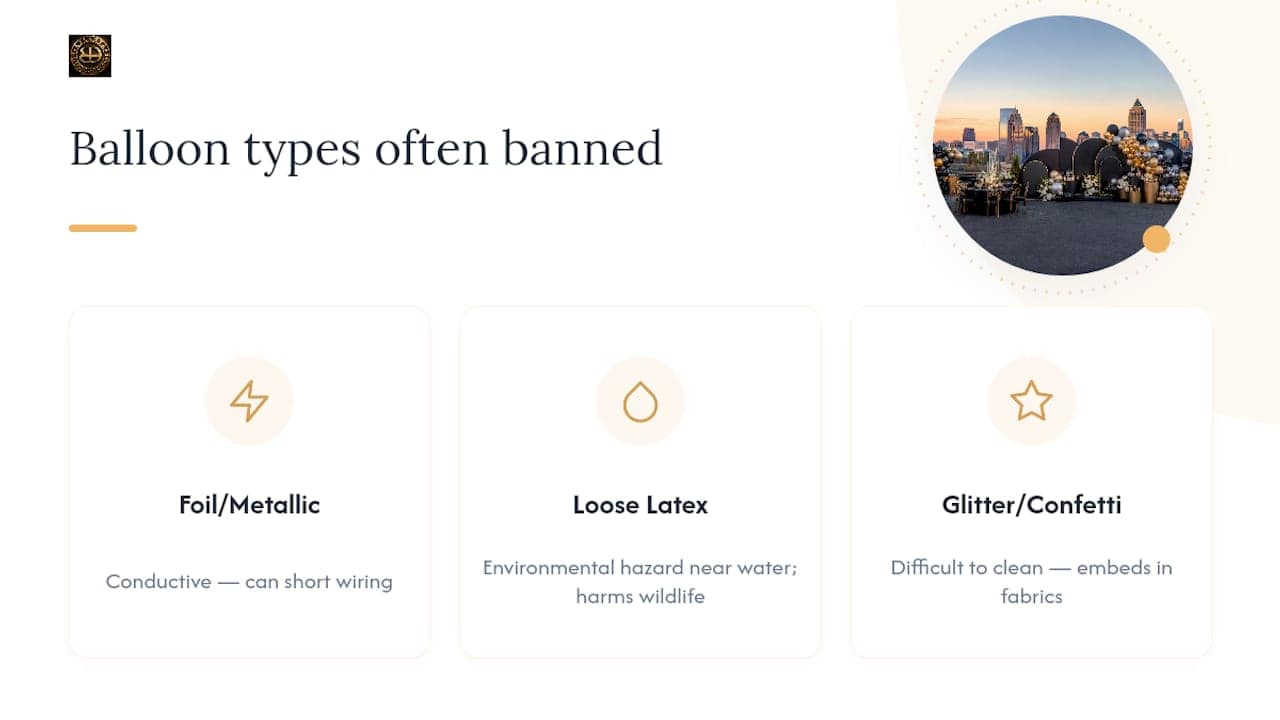
Metallic and foil balloons draw specific bans at a meaningful number of venues, and the reason is almost always electrical. Foil balloons conduct electricity, and a stray one drifting into exposed wiring, a light fixture, or overhead power lines has caused real property damage and outages elsewhere, which is exactly why some venues write metallic balloons into their prohibited-items list by name rather than lumping them in with “all balloons.”
Latex balloons face a different objection at outdoor or nature-adjacent venues: environmental policy rather than fire code. A property near water features, wildlife habitats, or conservation land may restrict any loose or released latex balloon regardless of material, since even biodegradable latex can take months to break down and poses a hazard to animals that mistake fragments for food.
Glitter-filled and confetti-filled balloons show up on prohibited lists for a more mundane reason: cleanup. Once a glitter balloon pops, the mess embeds in carpet fibers and upholstery in a way that standard housekeeping can’t fully remove, and venues have started billing for it accordingly.
The takeaway for planners is simple: never assume “balloons are allowed” covers every balloon type. Ask specifically about foil, glitter-filled, and any loose or released designs, since these are the categories most likely to carry a separate rule from your general decor approval.
Can You Use Open Flames or Heaters Near Balloon Decor?
Almost universally, no. Latex and foil balloons are both flammable or heat-sensitive enough that venues treat open flame near decor as a straightforward fire-code violation, not a gray area. Candles, sternos for catering, tabletop fire features, and space heaters all fall under this restriction when they’re positioned near an arch, garland, or backdrop.
The practical distance matters more than most planners realize. A candle several feet away can still radiate enough heat to warp or pop nearby latex, which is why event designers typically keep an even wider buffer than the venue’s stated minimum, especially around tall centerpieces or floating candle displays that sit close to garland runners.
Heat lamps and patio heaters at outdoor or tented events deserve the same caution. If your venue is hosting a cooler-weather event with heaters near a balloon backdrop or photo area, confirm the placement plan with the venue’s operations team before setup, not after the heaters are already running. This is one of the few restrictions where the safety math is identical no matter what the balloon material is, latex or foil, so there’s no version of “the rule doesn’t apply to us” that holds up.
What Happens to Balloons After the Event?
Disposal is quietly becoming its own line item in venue decor policies, particularly at properties near green space, water, or with sustainability commitments written into their brand. Most venues expect the hired vendor or planner to remove all balloon material during the strike window, not leave it for housekeeping to bag and haul out.
Latex balloons are technically biodegradable, but that process takes months outdoors, which is why a growing number of venues explicitly prohibit any release, indoor or outdoor, regardless of material. Several states and municipalities have gone further and banned intentional balloon releases outright due to wildlife and litter concerns, so even if your venue doesn’t mention it, checking local ordinances before planning a release-style finale is worth the five minutes it takes.
For standard installations, popping and bagging deflated balloons for disposal, rather than leaving them intact, is the more common venue expectation, since intact balloons left behind tend to drift, pop unexpectedly, or end up as helium clutter in a storage room. If your event is at an outdoor venue or one bordering a park or waterway, ask directly whether they have a formal environmental policy for decor disposal. Increasingly, they do.
Atlanta Balloon Designer’s Perspective on Venue Compliance
Kay here. What we’ve learned working with venues across metro Atlanta is that approval friction almost always traces back to one missing step: nobody put anything in writing before build day. A site visit and a digital mockup solve most of this before it becomes a problem, because the venue sees exactly what’s going up, exactly how it’s anchored, and exactly what materials touch their property.
Insured, certified installers also change the conversation entirely. A COI and a documented material list turn “no balloons in this ballroom” into “yes, with these specifications,” more often than planners expect. If you want the templates we use for these conversations, our venue coordination guide and delivery and setup guide walk through both.
— Kay
Let Atlanta Balloon Designer Handle Venue Approvals for You
Atlanta Balloon Designer is the alternative to piecing together your own compliance plan: we handle the site visit, the digital mockup, the vendor insurance paperwork, and the certified rigging conversation so you never have to interpret a venue’s decor policy alone. Every install starts with a site visit at $250 and a digital mockup at $75 per design, so your venue coordinator signs off on the exact look before we ever inflate a balloon.

From Austell to Marietta, Buckhead, Roswell, and everywhere else within 60 miles of Atlanta, our team builds freestanding arches, garlands, and marquee-letter installations that clear even the strictest fire-code and property-protection clauses. Explore our full range of corporate and grand-opening balloon services or browse luxury event styling packages for baby showers, birthdays, and milestone celebrations. Ready to move forward? Request a site visit and mockup today, and we’ll bring your venue’s written policy and your vision into the same room.
Sources
For deeper reference, the NFPA’s codes and standards cover sprinkler and egress rules cited across most venue policies. Belmont University’s decorations policy is a solid real-world example of typical prohibitions and fees.
- NFPA — Codes and standards
- Belmont University decorations policy (sample venue policy)
- Fiore Designs — Balloon delivery guide
FAQ
What States Have Banned Balloon Releases?
Several states and cities restrict or ban intentional balloon releases due to wildlife and litter concerns, though the specific list changes as local ordinances update. Always check your event’s state and municipal rules directly rather than assuming a release is permitted just because your venue allows balloons generally.
What Are the Rules for Hot Air Balloons Near Events?
Hot air balloons fall under separate FAA and aviation regulations entirely distinct from decorative balloon rules, and they require licensed pilots and designated launch clearance. If your event includes an actual hot air balloon feature, that falls outside standard decor venue restrictions and needs its own aviation-compliant planning.
Can I Set Up a Balloon Arch Two Days Before a Party?
It depends entirely on the balloon type and the venue’s load-in schedule, not just balloon longevity. Air-filled organic arches and garlands can often be built one to two days ahead since they don’t rely on helium, but confirm your venue’s load-in window allows early access before you plan around it.
Are Balloon Releases Illegal in Ohio?
Ohio does not have a blanket statewide ban on balloon releases, but individual municipalities may have their own ordinances restricting them. Check your specific city or county rules, and separately confirm your venue’s own environmental policy on disposal and release, since venue rules can be stricter than local law.
What Does Atlanta Balloon Designer Charge for a Site Visit?
A site visit to walk through venue rigging points, load-in access, and decor policy compliance is $250. It’s the step we recommend before finalizing any design for a venue with restrictions you haven’t confirmed in writing.