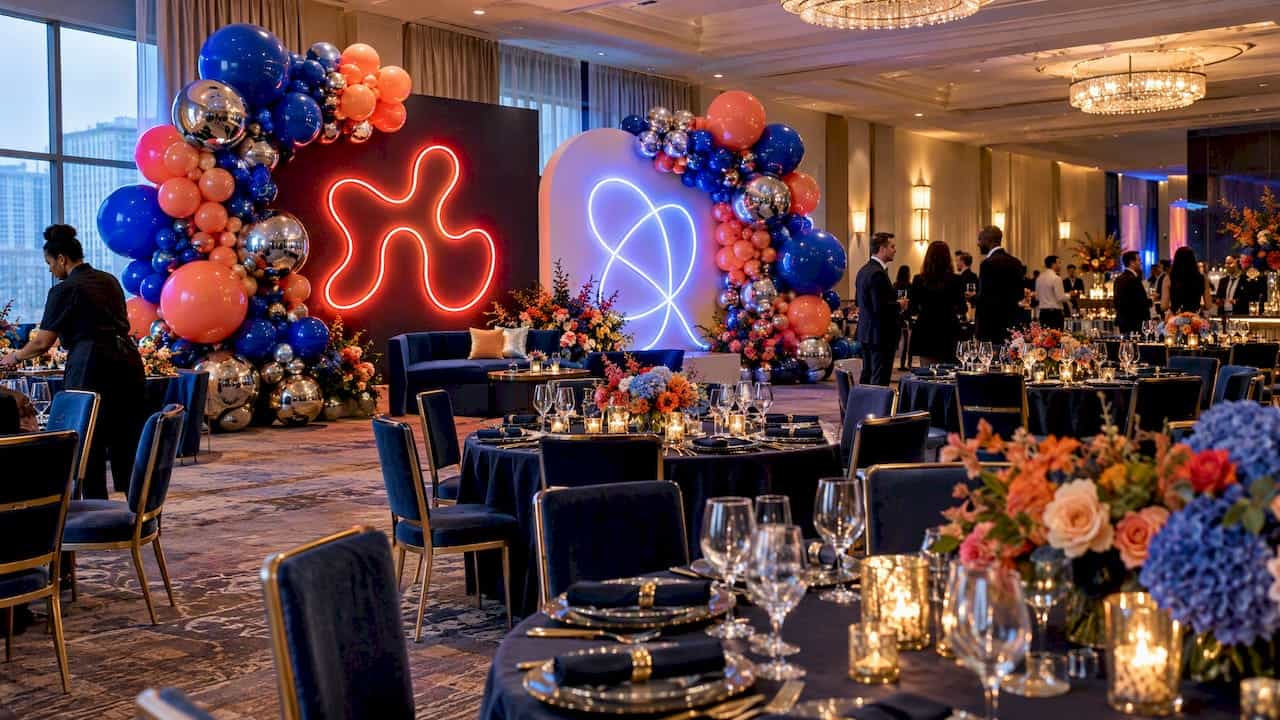
Choose glass neon when you want a warm, artful glow for close-up photography, intimate venues, or a vintage mood, and choose LED when you need energy efficiency, long-distance readability, and low maintenance for storefronts or large venues. LED signage typically cuts energy use dramatically compared with older light sources, while neon still wins on that signature soft shimmer but uses more energy. The sections below walk through the technical differences, costs, and a simple checklist to match the right technology to your project.
TL;DR:
- LED conversions can cut energy use by 70% to 80%, while many white LEDs reach L70 between 35,000 and 50,000 hours, depending on design.
- Glass neon repairs often require a glass bender, while LED signs need driver or module service; ask suppliers to cover the complete assembly, including housing.
- For retrofits, use only UL listed kits to preserve the cabinet’s safety listing, and verify applicable UL certification, NEC wiring compliance, and installer licensing.
- For event photos, adjustable color temperature gives photographers more control than warm neon, and site visits can catch power, lighting, and sightline problems before installation.
Table of Contents
- How glass neon and LED “neon” differ in construction
- How they look: glow quality and reading distance
- Power use and operating cost: why LEDs usually save money
- Realistic lifetime and maintenance you should plan for
- Codes, certifications, and installer qualifications to verify
- Upfront costs, retrofit options, and what shapes quotes
- Practical checklist to decide between neon and LED for your project
- Event design guidance: matching signs to decor and photo needs
- A note on balancing mood and practicality
- How we help bring your signage and decor vision together
- FAQ
- Sources
How glass neon and LED “neon” differ in construction
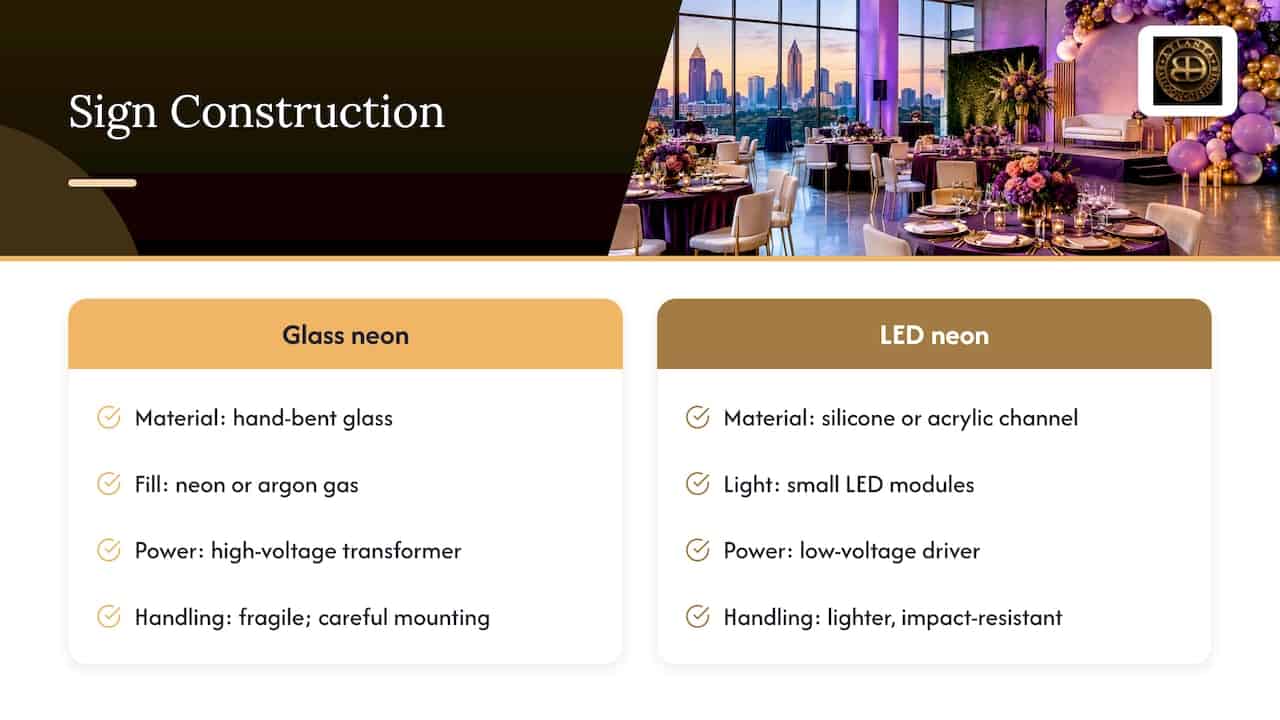
Traditional neon signs use hand-bent glass tubes filled with neon or argon gas, lit by a high-voltage transformer that excites the gas into that glowing line of color. It is delicate, custom-crafted work, and every curve is one of a kind.
LED alternatives, often called LED neon or flex, swap the glass tube for a flexible silicone or acrylic channel packed with small LED modules, powered by a low-voltage driver instead of a transformer. Some LED signs use rigid acrylic channel letters rather than flexible tubing.
That construction difference shapes everything downstream: glass neon is fragile and requires careful mounting, while LED units are lighter, more impact-resistant, and easier to ship, store, and reposition for different events.
How they look: glow quality and reading distance
Glass neon produces a soft, slightly diffused glow that reads as warm and dimensional, especially up close, which is why it remains a favorite for bar signage, art installations, and vintage-style branding. LED signs tend to produce a flatter, more even light across the face of each letter, often at a higher apparent brightness, which helps at a distance.
Sign-research field studies found that internally illuminated signs, including neon, often deliver 40 to 60 percent longer nighttime legibility distances compared with externally illuminated options. That matters for anyone weighing visibility against mood.
A few practical design notes worth keeping in mind:
- Taller letters and higher contrast backgrounds improve legibility at any distance, regardless of technology.
- Limiting your color palette to two or three tones keeps both neon and LED signs easier to read quickly.
- Neon tends to win the mood contest for intimate, close-viewing settings like photo backdrops or boutique storefronts.
Power use and operating cost: why LEDs usually save money
LED conversions can cut sign energy use by roughly 70 to 80 percent compared with traditional light sources in some implementations, according to Department of Energy reporting, with one retail case study documenting an 80 percent power reduction after a storefront switch. Lower wattage also means less heat output, which eases strain on HVAC systems near large illuminated displays.
Roughly 70 to 80 percent lower energy draw is the headline reason retailers and venues are shifting toward LED signage. (energy.gov)
To estimate your own operating cost difference:
- Find the wattage of your current sign and multiply by daily operating hours.
- Multiply that figure by your local electricity rate per kilowatt-hour.
- Repeat the calculation using the LED replacement’s wattage and compare the two annual totals.
Realistic lifetime and maintenance you should plan for
LED lifetime is usually described through lumen depreciation, measured as L70, the point at which output drops to 70 percent of its original brightness. DOE and EERE guidance notes that many high-power white LEDs are projected to reach L70 somewhere between 35,000 and 50,000 hours, depending on thermal and electrical design, not the diode alone.
Repairs look different for each technology:
- Glass neon failures usually mean a cracked tube or a gas leak, which requires a glass bender to fix properly.
- LED signs more commonly need driver replacement, module swaps, or lens cleaning rather than full sign replacement.
Pro Tip: Ask any supplier for the warranty on the complete sign assembly, including the driver and housing, not just the LED diode’s rated hours.
Codes, certifications, and installer qualifications to verify
Before committing to any sign, confirm it carries the right safety documentation. Look for UL listings under UL 48 for neon and UL 879 or 879A for electronic signage, along with compliance with NEC Article 600 for sign wiring.
OSHA guidance also flags that maintenance on large illuminated signs can trigger confined-space or lockout-tagout verification requirements, so qualified personnel should confirm de-energization before servicing. Ask any installer for proof of licensing, the sign’s UL listing, and written installation instructions before signing off on a project.
Upfront costs, retrofit options, and what shapes quotes
Several factors drive the price gap between a budget sign and a premium custom piece: overall size and letter count, the complexity of custom glass bending for neon, driver quality for LED units, local permit fees, and labor rates for licensed electricians.
Retrofit kits that convert an existing neon cabinet to LED can lower costs and speed up a project, but only UL-listed retrofit kits preserve the sign’s original safety listing. A non-certified kit can void that listing and trigger a new inspection by your local authority having jurisdiction.
When comparing quotes, ask about:
- Whether the price includes permits, installation, and electrical hookup, or only the sign itself.
- The expected lifespan of the driver versus the lighting element.
- Lead time for custom glass work versus a standard LED module order.
Practical checklist to decide between neon and LED for your project
Match your choice to four factors: appearance, viewing distance, operating budget, and how much ongoing maintenance you can handle.
- If close-up warmth and a vintage mood matter most, lean toward glass neon.
- If the sign needs to read clearly from across a parking lot or busy street, lean toward LED.
- If your operating budget is tight long term, LED’s lower energy draw usually wins.
- If you want minimal hands-on maintenance, LED’s driver-based repairs are typically simpler than glass work.
| Priority | Better fit | Why |
|---|---|---|
| Close-up ambience, photo backdrops | Glass neon | Softer, warmer glow at short range |
| Long-distance readability | LED | Higher apparent brightness, even face |
| Lower operating cost | LED | 70 to 80 percent less energy use |
| Low ongoing maintenance | LED | Driver and module service versus glass repair |
Before you commit, ask suppliers directly about warranty length, UL listing, expected L70 hours, driver replacement policy, and lead time. Those five answers settle most buying decisions fast.
Event design guidance: matching signs to decor and photo needs
We work with both LED and neon signage when styling corporate events, baby showers, and milestone celebrations, and light temperature changes everything in a photo. Warm neon glow can shift skin tones and balloon colors in camera, while LED units with adjustable color temperature give photographers more control when pairing signage with marquee letters and organic balloon backdrops.
Placement matters too: we keep hot light sources clear of latex balloons and florals, and we stage marquee letters and photo backdrops so the sign becomes the focal point rather than competing with your balloon arch. We coordinate sign placement with venue lighting during our site visits so everything reads beautifully in photos.
A note on balancing mood and practicality
Great signage decisions come down to knowing what the room needs to feel like and what the sign needs to do. We have seen gorgeous neon pieces fail a venue simply because nobody checked sightlines first, and that single planning step saves more headaches than any spec sheet.
— Kay
How we help bring your signage and decor vision together
Once you have picked your sign, we help build the rest of the room around it. Our team offers:

- Digital Mockup Services to preview how signage, marquee letters, and balloon colors will look together before you commit.
- Site visits to check venue power, lighting, and sightlines ahead of your event.
- Luxury Event Styling for full-service coordination, from tablescapes to candles to custom balloon installations.
- Corporate Event Balloon Decor for brand activations, grand openings, and retail launches that pair signage with statement decor.
If you are planning an event in Atlanta or within 60 miles of the city, we would love to help you pull it together. Browse our balloon decor pricing or reach out to book a consultation and get your mockup started.
FAQ
What is the downside of LED lights?
LED signs can look flatter or cooler than glass neon at close range, and their perceived warmth depends heavily on the driver and color temperature chosen. Whole-sign lifespan also depends on the driver and housing quality, not just the LED diode rating.
Do neon signs use AC or DC?
Traditional glass neon runs on high-voltage alternating current supplied through a transformer that excites the gas inside the tube. LED neon alternatives typically run on low-voltage DC power delivered through a driver.
Why are neon lights not used anymore?
Neon has not disappeared, but LED has become the default choice for many businesses because of its lower energy use and easier maintenance, with some LED conversions cutting power use by 70 to 80 percent. Glass neon remains popular for vintage branding, art pieces, and close-up photo settings where its distinctive glow still outperforms LED.
What are the types of neon signs?
The main categories are traditional glass tube neon, bent and filled by hand, and LED neon flex, which mimics the look using flexible LED strips inside a silicone or acrylic channel. Rigid LED channel letters are another common option for storefront signage that prioritizes durability over the classic glass glow.
Sources
- Lifetime of White LEDs — DOE / EERE publication
- Illuminated sign conspicuity — Sign Research Foundation
- UL — Solutions for electric sign and sign component manufacturers