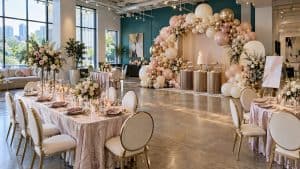
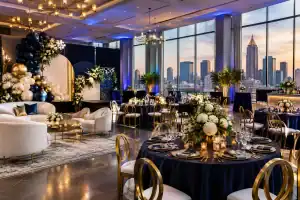
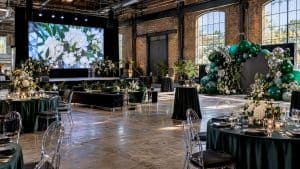
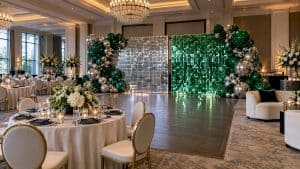
For most indoor events in Atlanta, a tension fabric backdrop is the better choice. Think corporate step-and-repeats, product launches, grand openings, galas, baby showers and first birthdays. Fabric gives a matte, wrinkle-free surface that looks polished in person and photographs cleanly under flash and stage lighting. Vinyl earns its place when the backdrop will sit outdoors in weather or take rough handling. This guide shows how the two compare, how to match each to your event, and what to check before you order.
TL;DR
- Fabric has a soft, matte, low-glare finish that photographs beautifully indoors, and it packs small for transport.
- Vinyl is a durable, weather-ready banner material. It reflects more light, so it can create hotspots under flash and spotlights.
- Choose by where the backdrop stands, how it will be lit and photographed, and how many times you will use it.
- Size the photo area for your guests: about 2 feet of backdrop width per person, and a standard height of 8 feet.
- We design, deliver and set up tension fabric backdrops in Atlanta and the surrounding 60-mile area, and we can pair them with balloon installations.
Table of Contents
- The Short Version: What Actually Separates Fabric From Vinyl
- Why Light Decides the Winner at Most Events
- When Tension Fabric Is the Right Call
- When Vinyl Makes Sense
- Cost, Reuse and Return on Your Investment
- Venue Rules and Fire Safety: Check Before You Print
- How to Size a Photo Backdrop for Your Guests
- Setup, Lighting, Cleaning and Storage
- Printing Basics That Protect Your Brand Colors
- Beyond the Flat Wall: Pairing Fabric With Balloons and Styling
- A Quick Decision Checklist
- Our Perspective
- Plan Your Backdrop With Atlanta Balloon Designer
- FAQ
- Sources
The Short Version: What Actually Separates Fabric From Vinyl
The difference starts with what each material is made of and how it is printed. Fabric backdrops are typically polyester textile printed by dye sublimation, a process that bonds dye into the fibers. They are usually fitted over a tension frame that folds down for packing. Vinyl backdrops are PVC banner material, usually hemmed and grommeted, and hung from a stand, truss or fence.
That difference in construction explains almost every trade-off you will read about:
| Factor | Tension fabric | Vinyl |
|---|---|---|
| Surface | Matte, soft, low reflection | Smoother, more reflective unless matte-finished |
| Photos and video | Spreads light evenly under flash and LED lighting | Can show bright patches under directional light |
| Wrinkles | Tension pulls the surface smooth | Folds can set in and be hard to remove |
| Best location | Indoors | Indoors or outdoors |
| Transport | Folds small | Rolls onto a tube |
| Edges and hardware | Clean, tailored look | Often finished with visible grommets |
SmartPress, a commercial printer, gives the same rule of thumb in its fabric vs. vinyl guidance: fabric for a softer, less reflective look and easy transport, vinyl when durability or long exposure to the elements matters most.
Why Light Decides the Winner at Most Events
A backdrop is judged in photographs. Guests post them, your communications team files them, and the press picks them up. What the camera sees depends on how the surface handles light.
Vinyl reflects light. Under a camera flash, a spotlight or the LED cans in a ballroom, a glossy or semi-gloss surface can throw back bright patches that wash out a logo or a face. Printers who make both materials note that fabric’s low-reflective surface suits photography and flash environments, and that vinyl can reflect sunlight and flash more readily.
Fabric also changes how color reads. Dye-sublimated fabric tends to look slightly warmer and softer under lights, with rich, even color. Vinyl can look crisper and a little cooler, with punchy solid colors. If your design relies on fine lines or very small text, vinyl holds that detail a touch more sharply at close range. If your design is a large logo, a repeat pattern or a photographic scene, fabric gives you a premium look with no glare to fight.
For a planner, that translates into three practical rules:
- Flash-heavy photo areas (step-and-repeats, red-carpet walls, VIP arrivals): choose fabric.
- Filmed stages and interviews where video lights and cameras face the wall: choose fabric.
- Bright daylight or outdoor activations: vinyl handles the exposure better, and a matte finish keeps glare down.
If you are planning a photo moment around your brand, our guide to the role of backdrops in photography goes deeper on framing, lighting and guest flow.
When Tension Fabric Is the Right Call
Fabric is the natural choice for indoor, photo-first events, which describes most of what Atlanta planners book:
- Corporate step-and-repeats and sponsor walls. Logos stay crisp and glare-free, and the wall looks the same in the first photo as in the five-hundredth.
- Product launches. The backdrop is the hero of the launch photos. See how planners approach this in our photo-first product launch backdrops.
- Conference stages, keynotes and awards nights. Stage lighting and video favor a matte surface.
- Grand openings and ribbon cuttings held in a lobby, showroom or storefront.
- Luxury baby showers, first birthdays and engagement parties where the backdrop frames a dessert table or a mother-to-be portrait.
Printers who serve convention clients say the same thing. Design One Printing’s convention guide describes dye-sublimated polyester as the better option for glare control and photo consistency under LED lights and camera flashes, and it points out that fabric can often be made in a seamless, ultra-wide format, where vinyl may need paneling or welded seams.
Two more benefits matter for repeat users. First, fabric is lightweight and folds into a small bag, so it travels well. Second, it can be reused: many polyester fabric graphics can be machine-washed on a gentle cycle, which helps if you roll the same design out across several events.
When Vinyl Makes Sense
Vinyl is a good material in the right setting. Choose it when:
- The backdrop is outdoors and will face sun, wind or rain. Heavier vinyl is built for that. SmartPress recommends 13 oz. scrim vinyl for outdoor use and 15 oz. smooth vinyl for extended outdoor use, and notes its UV-curable ink produces fade-resistant graphics.
- The wall will take knocks, such as festival grounds, sports sidelines or fences.
- You need print on both sides. Vinyl can be printed double-sided, which fabric frames generally are not.
- It is a one-time, low-budget job where the look in photos is secondary.
If you choose vinyl for a photo area, pick a matte finish. Glossy vinyl under flash is the most common cause of washed-out photo walls. And plan how it is stored: vinyl should be rolled or kept flat, because folds can set and wrinkles are hard to remove.
For an Atlanta outdoor event, such as a tree lighting or a patriotic celebration in a park, the weather in Georgia (afternoon storms, summer heat) is a good reason to treat the backdrop as part of the outdoor setup. Many of our outdoor installations pair a sturdy structure with balloon work designed for the setting. Our team can talk you through the right approach for your site.

Cost, Reuse and Return on Your Investment
Printers generally rate fabric as a mid-to-high cost option and vinyl as low-to-mid, per SpeedPro’s materials comparison. The difference matters less than how often you use the piece.
A simple way to think about it:
- One event, one design, outdoors: vinyl keeps the cost down.
- One design, many events: fabric tends to pay back. It packs flat, resists wrinkles and keeps its look from show to show.
- A design that changes every time (new sponsor, new date, new theme): the lower cost of a printed banner can make sense, or a rental of a fresh fabric graphic for each event.
When you budget a backdrop, include what surrounds it: delivery, installation, strike-down and any lighting. For our own services, our published pricing lists delivery, setup and strike-down from $125, and a site visit at $250. That helps you build a realistic total before anyone arrives at your venue. For a wider view of what corporate décor costs in the market, see our corporate event decor pricing guide.
Venue Rules and Fire Safety: Check Before You Print
This is the step that most often catches planners out. Many convention centers, hotels and public venues have fire-safety rules for hanging textiles and banners. SpeedPro notes that high-quality trade show fabrics are typically pre-treated and certified to NFPA 701 fire standards, and that you should ask for the documentation. Standard vinyl is often not fire-resistant, so some indoor venues require a flame-retardant vinyl.
Before you commit to any material:
- Ask the venue’s event manager what fire-rating paperwork they require for hung or freestanding graphics.
- Ask for the fire certificate of the material you intend to use and keep a copy in your event binder.
- Confirm the maximum height, load-in route and any restrictions on rigging to the ceiling or walls.
The local fire marshal or the venue’s safety office has the final say, so this is the authority to ask when a venue’s rule is unclear.
How to Size a Photo Backdrop for Your Guests
A backdrop that is too small is the most common reason a photo area feels cramped. Vancke’s event guide recommends 2 feet of backdrop width per person and a standard 8-foot height. In practice:
| Group in the photo | Backdrop width |
|---|---|
| A couple | 4 ft. |
| A five-person team | at least 10 ft. |
| A larger group or a stage-front wall | wider, with extra on both sides for camera framing |
Add a tape line on the floor four to five feet in front of the wall so guests know where to stand, and leave a clear area for the photographer. For conference-specific sizing and layout, our guide to conference photo backdrop design, sizing and setup walks through the details.
Setup, Lighting, Cleaning and Storage
Good material still needs good setup. Here is the routine we recommend for a tension fabric wall, and what to watch at each step.
- Level the floor and place the frame. An uneven floor makes the fabric ripple. Fabric should hang under gentle, even tension, or it will show waves.
- Slide the fabric sleeve over the frame and pull it taut. This is where installation experience pays off: a fabric graphic that is pulled evenly looks seamless, while one pulled unevenly distorts the logo. When we install, we handle delivery, setup and strike-down for you.
- Steam minor fold lines. A hand-held steamer is safer than an iron for removing wrinkles.
- Light the wall evenly. Aim key and fill lights at about 45 degrees to the surface, then test with a flash before guests arrive. If your event also includes staging and a dance floor, an experienced team for event lighting and staging production can plan the lighting for the whole room, not just the wall.
- Plan the strike. Fabric folds into a bag; vinyl rolls onto a tube. Neither should be stored in damp conditions or direct sun. Dry, ventilated storage away from sunlight prevents mold and fading.
For cleaning, most polyester fabric backdrops can be machine-washed on a gentle cycle in cold water and air-dried, not tumble-dried, ironed or bleached. Vinyl wipes down with a damp, clean cloth.
If you want the backdrop to come with a design, delivery and installation team, that is what we do for corporate events, grand openings and backdrops and photo booths.
Printing Basics That Protect Your Brand Colors
A few production details prevent most disappointments:
- Resolution. Supply artwork at 150 PPI or higher at final size, per SmartPress guidance.
- Opacity. Heavier fabric is more opaque, so graphics are harder to see through when lit from behind.
- Color. Screens and print differ. Review a proof or a mockup before production, especially for brand colors.
- Match material to artwork. A dark photographic design on glossy vinyl can show unwanted reflections, while a simple large-type logo may suit almost any finish.
We offer digital mockups at $75 per mockup, so you can see how the backdrop and any balloon elements will look together before you approve the design.
Beyond the Flat Wall: Pairing Fabric With Balloons and Styling
A flat printed backdrop gives you brand clarity. Balloons give you dimension. Many of our favorite photo moments combine the two: a clean fabric wall with an organic balloon arch or garland framing it, or marquee letters in front of it, so the guest photo carries both the logo and the sense of celebration.
This works across your event types:
- Corporate and brand activations: a branded fabric wall with a sculptural balloon frame in your company palette.
- Grand openings: a fabric backdrop behind the ribbon-cutting with balloon columns on either side.
- Luxury baby showers and first birthdays: a soft fabric scene in neutrals, with an organic garland that carries gold and blush accents.
For design inspiration, browse the types of photo op backdrops or see what a balloon backdrop can add.
A Quick Decision Checklist
Answer these five questions and the material usually chooses itself:
- Indoors or outdoors? Indoors points to fabric. Outdoors in weather points to vinyl.
- Will there be flash, video or stage lighting? If yes, fabric.
- How many events will it serve? Several, fabric. One, either works.
- Does the venue require fire documentation? Confirm before you print.
- How many people will stand in front of it? Allow 2 feet of width per person.
Our Perspective
We think of a backdrop as the first thing a guest photographs and the last thing they remember. That is why, for indoor events, we reach for tension fabric first. The surface is smooth and wrinkle-free, it keeps glare off the lens, and it shows brand colors and logos with a clean, tailored finish and no visible grommets.
Our approach is to design the whole picture, not only the print. A fabric wall is the calm, polished foundation. Balloon arches, organic garlands, marquee letters and florals add the energy and the dimension that make guests stop, pose and share. We plan the palette, the floor layout and the photo flow together, so the wall, the lighting and the decor look like one idea.
If you are a planner juggling a venue, a timeline and a client’s brand standards, hand us the backdrop. We will bring the design, the delivery and the setup, so you can focus on your guests.
Kay
Plan Your Backdrop With Atlanta Balloon Designer
We are an award-winning luxury balloon décor and event styling company in Austell, serving Atlanta, Marietta, Sandy Springs, Buckhead, Midtown and communities within a 60-mile radius. We create premium tension fabric backdrops and custom frames, and we combine them with balloon installations, marquee letters, tablescapes and full event styling for corporate events, grand openings, luxury baby showers and birthdays.

Tell us your venue, date and guest count, and we will recommend the right backdrop and show it to you in a digital mockup. Explore our luxury event styling or call us at 678.203.0200 to book your design consultation.
FAQ
Is a fabric backdrop better than vinyl for photos?
For most indoor photo areas, yes. Fabric has a matte, low-reflective surface, so flash and event lighting are less likely to create bright patches. That keeps faces, logos and colors looking consistent from one photo to the next. Vinyl is the stronger choice for outdoor use.
Can I use a fabric backdrop outdoors?
Fabric is mainly designed for indoor use. It can work briefly outdoors in mild weather, but it absorbs moisture and dirt more readily than vinyl. For an extended outdoor event in Georgia’s heat or storms, a heavier vinyl is the sturdier material.
How big should a step-and-repeat backdrop be?
Allow about 2 feet of width per person in the photo, so a couple needs about 4 feet and a five-person team about 10 feet. The standard height is 8 feet. Add extra width on each side so the camera can frame the group without catching the room.
How do I get wrinkles out of a fabric backdrop?
Use a hand-held steamer on low, held a little away from the fabric. Avoid an iron, which can scorch polyester. Fabric that is pulled evenly over its frame will show fewer fold lines to begin with.
Do I need fire-rated material for my venue?
Many convention centers and hotels have rules for hung textiles and graphics. Ask the venue what documentation they require, and request the fire certificate for your material before printing. If a rule is unclear, ask the venue’s safety office or the local fire marshal.
Sources
- SmartPress: Fabric Backdrops vs. Vinyl Backdrops
- Design One Printing: Convention Backdrop Materials Guide
- SpeedPro: Fabric vs Vinyl vs Hard-Panel Trade Show Backdrops
- Vancke: Step-and-Repeat Backdrops for Events
- My Inkjet: Fabric Backdrop vs Vinyl Backdrop
- Craftsmen Industries: Maintaining and Storing Your Backdrop
- Lost Wax Band: Event Production