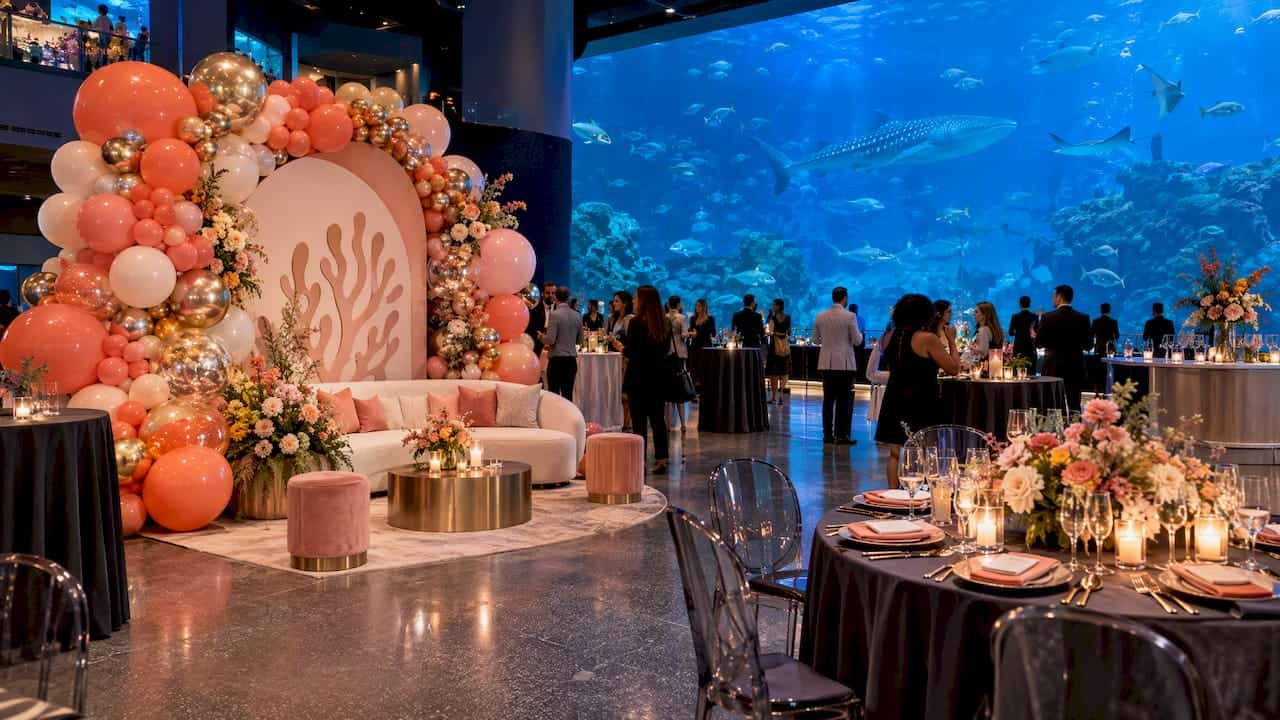
The fastest way to build an engaging Atlanta corporate event is to pick an activity format that fits your headcount and season, lock in a venue built to support it, and bring in a full-service stylist to make the room camera-ready. Atlanta gives planners rare range: aquarium galleries, entertainment campuses, and skyline-view ballrooms are all within one metro area. Choose your format, check venue availability, and brief your decorator early.
TL;DR:
- Outdoor field days suit 50 to 300 guests, but planners should reserve rain dates from May through October because afternoon storms are common.
- Before signing, confirm approved vendors, exclusive AV rules, loading dock hours, insurance, parking, and MARTA access; venue accessibility varies by age and layout.
- Start planning 90 days ahead to cover venue deposits, vendor requests, site visits, floor plans, headcount, and final AV checks; late submissions can trigger fees.
- Cooking or floral workshops generally need one facilitator per 25 to 40 guests; confirm power, permits, and setup limits with the venue beforehand.
- For an event with 150 guests, venue rental and catering each take 30% of the sample budget, while decor and AV each account for 15%.
Table of Contents
- Corporate event ideas by format for every team size
- How to choose the right Atlanta venue for your event
- Running the day: entertainment flow, staffing, and site checks
- Timeline, budget, and group-ticket logistics
- How Atlanta Balloon Designer elevates a corporate event’s design
- Atlanta-inspired corporate event themes worth stealing
- Pairing balloon decor with other Atlanta vendors
- Customizing balloon design to match your brand
- Measuring the impact of event decor on attendee perception
- Scalable balloon decor packages for every event size
- What I’ve learned styling Atlanta’s corporate events
- Ready to style your next Atlanta corporate event
- FAQ
- Sources
Corporate event ideas by format for every team size
Atlanta’s mix of attractions, green space, and entertainment districts means almost any format you picture has a real address to match it. Here’s a working menu organized by the kind of experience you want to deliver, with quick notes on group size, setting, and season so you can shortlist fast.
Outdoor and park-based gatherings
- Picnic-style team lunch: A relaxed outdoor meal with lawn games works well for groups of 20 to 150 and suits parks or hotel lawns with shade coverage. Spring and fall are ideal; Atlanta summers call for tenting or a shaded pavilion.
- Corporate field day: Classic relay races, tug-of-war, and bean-bag tournaments fit mid-size teams of 50 to 300 and need a flat, open field. Reserve rain dates between May and October, since afternoon thunderstorms are common.
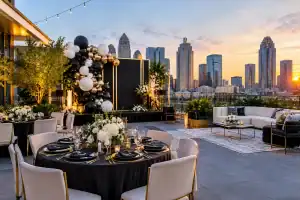
- Rooftop happy hour: A skyline-view cocktail hour suits 30 to 200 guests and works best from late spring through early fall when evening temperatures cooperate.
- Garden-set networking reception: A botanical or garden-style venue gives smaller groups, 20 to 100 people, an elegant backdrop without a formal ballroom feel.
- Outdoor film night: A branded screen, lawn seating, and food trucks suit 50 to 250 attendees and work well as a lower-key evening add-on to a daytime meeting.
- Lakeside or riverside retreat day: Waterfront properties outside the city core suit smaller leadership retreats of 15 to 60 people looking for a quieter setting.
Attraction-based experiences
- Aquarium evening buyout: A private or semi-private evening at the Georgia Aquarium pairs discounted group admission with behind-the-scenes tours and animal encounters, and it works for groups from 50 to several hundred depending on the gallery space booked.
- Zoo Atlanta themed event: Buyouts of themed spaces such as Savanna Hall give corporate groups a distinctive setting with built-in catering partnerships, suited to 100 to 500 guests.
- Sports stadium suite experience: Game-day suites or stadium tours fit client-entertainment groups of 10 to 80 and depend entirely on the home team’s schedule.
- Museum after-hours reception: History or art museums rent gallery space for evening receptions, ideal for 50 to 300 guests who want a sophisticated, conversation-friendly layout.
- World of Coca-Cola private tour: A branded, nostalgic option for groups of 20 to 150, strong for client appreciation events or out-of-town visitor days.
- College Football Hall of Fame activation: Interactive exhibits make this a good fit for groups of 30 to 200 who want a built-in activity layer alongside a reception.
Competitive and active team building
- Escape room tournament: Small teams of 4 to 8 compete across multiple rooms, scaling to total groups of 20 to 120 with staggered scheduling.
- Scavenger hunt through downtown or Midtown: App-guided hunts suit 30 to 200 people and work well paired with a happy hour finish point.
- Cooking competition, Iron Chef style: Teams of 6 to 10 compete at live stations, best for groups of 30 to 150 in a venue with commercial kitchen access or mobile culinary setups.
- Trivia night with a branded twist: Low-lift and low-cost, trivia formats flex from 20 to 300 people and work in almost any indoor venue.
- Mini golf or axe-throwing social: Entertainment-district venues offer these as turnkey activities for groups of 20 to 150.
- Charity build day: Teams assemble bikes, care packages, or furniture for donation, a strong option for 30 to 200 people who want a competitive element with a philanthropic payoff.
Culinary and tasting experiences
- Food truck festival on-site: Multiple trucks let large groups of 100 to 500 graze at their own pace, ideal for outdoor campuses with power access.
- Wine or bourbon tasting: A seated or stationed tasting suits 20 to 100 guests and pairs naturally with a networking reception format.
- Chef’s table dinner: An intimate, high-touch dinner for 10 to 40 executives works best in a private dining room or boutique venue.
- Southern-style buffet with live cooking stations: A crowd-pleasing option for 50 to 400 people that scales easily across venue types.
- Coffee and pastry branded cart: A low-cost morning touchpoint for any size group, useful as an add-on rather than a standalone event.
- Dessert bar with a signature cocktail pairing: Works for 30 to 200 guests at an evening reception and photographs beautifully against a styled backdrop.
Creative and experiential workshops
- Paint and sip session: Guided art classes suit 20 to 80 people and need table space plus easy cleanup access.
- Floral arranging workshop: A hands-on, branded take-home activity for 20 to 100 guests, often paired with a networking lunch.
- Design-your-own cocktail class: Mixologist-led sessions fit 20 to 100 people and work well as an icebreaker before a larger event.
- Branded photo booth activation: A styled backdrop and instant printing station works at any scale and doubles as content for internal recognition programs.
- Candle or fragrance blending class: A sensory, relaxed workshop for 15 to 60 guests, well suited to smaller leadership offsites.
- Live mural painting: An artist builds a branded mural live during the event, engaging 50 to 300 guests as passive or hands-on participants.
Virtual and hybrid formats
- Hybrid keynote with regional watch parties: A central speaker streams to satellite gatherings, useful for companies with distributed Atlanta-area teams.
- Virtual trivia bridging remote and in-person staff: Keeps remote employees engaged during an in-person celebration without excluding anyone.
- Livestreamed award ceremony: Combines an in-person stage with wide remote viewership, suited to companies recognizing achievements across multiple offices.
- Hybrid cooking class with mailed kits: Remote employees cook alongside an in-person group via video link, a creative way to unify a split workforce.
- Digital scavenger hunt: Works across in-person and remote participants simultaneously using a shared app.
- Hybrid wellness session: A yoga or meditation break streamed to remote staff while in-person attendees join live.
Several of these formats sit inside downtown or Midtown, both well served by MARTA rail, which simplifies arrival logistics for out-of-town guests flying into Hartsfield-Jackson. Whatever you choose, confirm ADA-accessible entrances, restrooms, and pathways early, since accessibility needs vary widely by venue age and layout.
How to choose the right Atlanta venue for your event
Once you’ve picked a format, the venue decision comes down to matching capacity, layout, and house rules to what you’re actually running. Atlanta offers five broad venue categories, and each comes with its own tradeoffs.
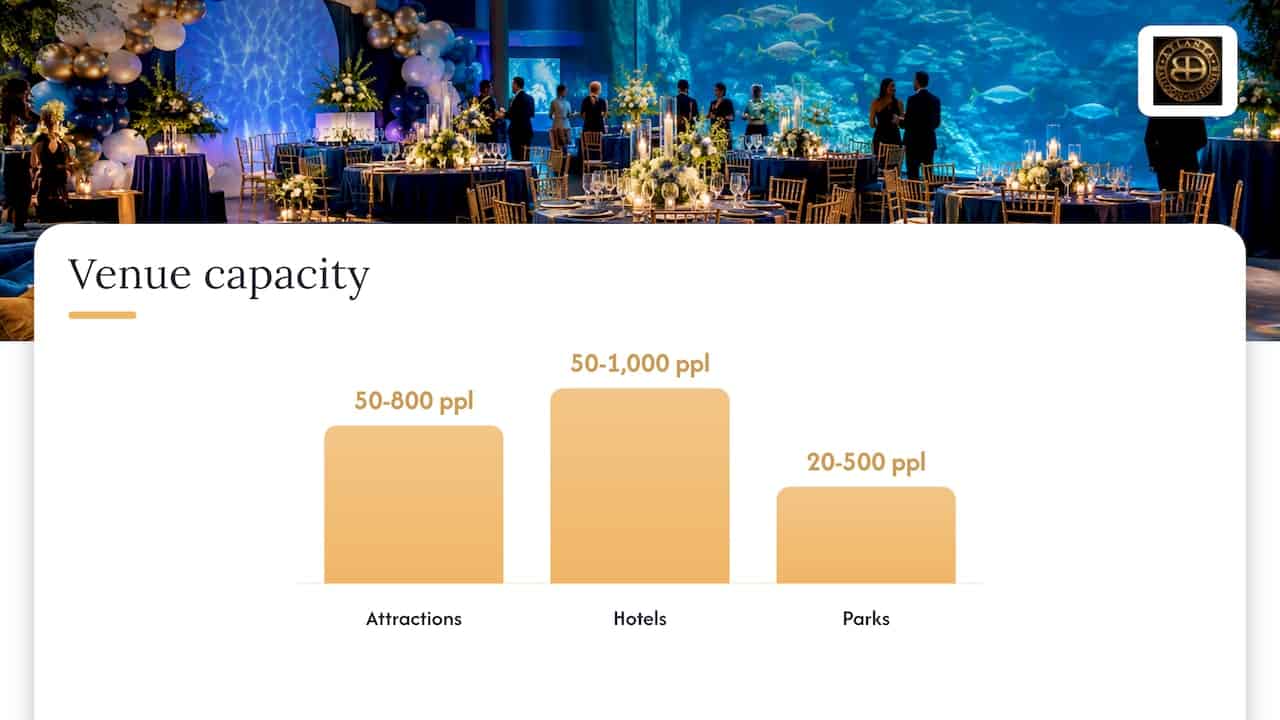
Attractions like aquariums, zoos, and museums typically host 50 to 800 guests depending on the gallery or hall rented, and they bring built-in wow factor along with built-in restrictions. The Georgia Aquarium’s FAQ page notes that large venues commonly require advance submission of floor plans, safety protocols, and production schedules, so planners should track facility-specific deadlines closely to avoid late fees.
Convention and arena campuses, led by the Georgia World Congress Center, handle everything from 500-person breakouts to citywide conventions. The GWCC offers more than 1.5 million square feet of exhibit space and structured planning guidelines, making it the default choice for large trade-show-style corporate events.
Hotel ballrooms remain the workhorse option for 50 to 1,000 guests, offering in-house catering, AV, and staffing under one contract, though that convenience often comes with exclusive vendor requirements.
Parks and outdoor spaces suit 20 to 500 guests and offer the most design flexibility, but they also carry the most weather risk and the fewest built-in utilities.
Entertainment campuses such as Battery Atlanta blend private event space with walkable dining and entertainment, scaling from intimate 20-person gatherings to multi-thousand-person activations, and they simplify logistics for mixed-program days that combine a meeting with a social component.
Before you sign a contract with any venue, verify:
- Approved vendor lists: Many venues require caterers, florists, and decorators to be pre-approved or insured to specific limits.
- AV and production exclusives: Some campuses, particularly convention centers and arenas, contract exclusively with in-house AV providers.
- Load-in and load-out restrictions: Freight elevator access, loading dock hours, and union labor rules can affect your setup timeline.
- Insurance requirements: Certificates of insurance naming the venue as additionally insured are standard for most attractions and convention campuses.
- Parking and transit access: Confirm whether parking is included, metered, or valet-only, and note the nearest MARTA station for guests arriving without a car.
Cvent’s guidance on Atlanta venue selection points out that prioritizing attendee travel patterns over sheer venue size tends to improve turnout for fly-in teams, since a venue near Hartsfield-Jackson with nearby hotel inventory reduces the friction of getting people in the door. Local resources like the ATL Airport District CVB can also help negotiate rates and assemble RFPs if you’re managing multiple venue quotes at once.
Running the day: entertainment flow, staffing, and site checks
How you structure the activity flow matters as much as which activity you pick. Four formats cover most corporate events:
- Central hosted format: One emcee or facilitator runs the full group through a single activity, ideal for award ceremonies, keynote-style programs, or trivia nights under 150 guests.
- Station rotation: Small groups rotate through multiple stations, such as a cooking competition or escape room circuit, which keeps energy high for larger headcounts without creating bottlenecks.
- Open-play social: Guests move freely between food, games, and lounge areas with no fixed schedule, well suited to happy hours and networking receptions.
- Facilitated competition: Teams compete head-to-head with a scorekeeper and structured rounds, the right choice for field days and charity build challenges.
Staffing needs scale with the format. High-touch, hands-on activities like cooking classes or floral workshops generally need one facilitator per 25 to 40 guests to keep instruction quality high, while open-play and station formats can run leaner with roaming staff.
Before contracting any entertainment vendor, confirm three things with your venue: available power capacity for equipment-heavy activities, any permits required for open flame, amplified sound, or outdoor structures, and the latest possible setup time the space allows. Skipping this step is the most common cause of day-of scrambles.
Pro Tip: Build in five-minute buffer transitions between activities, since even a well-planned rotation loses energy when guests stand around waiting for the next station to open.
Timeline, budget, and group-ticket logistics
A 90-day runway gives most Atlanta corporate events enough room to lock venue, vendors, and décor without rush fees. Use this milestone checklist as a baseline:
- 90 days out: Submit venue deposit, finalize guest count range, and request RFPs from catering and entertainment vendors.
- 60 days out: Confirm insurance certificates, schedule a site visit, and brief your decorator on branding and layout.
- 30 days out: Submit floor plans to the venue, confirm AV equipment list, and finalize group-ticket or attraction add-ons.
- 14 days out: Confirm final headcount, walk through the day-of schedule with all vendors, and verify load-in windows.
- 7 days out: Final AV check, confirm décor install time, and distribute the day-of contact sheet to all vendors.
Common extra fees that catch planners off guard include after-hours labor rates, rush floor-plan submission fees, and vendor insurance add-ons for anyone not on a venue’s approved list. A mid-range corporate event for 150 guests might break out roughly like this:
| Budget category | Share of total budget |
|---|---|
| Venue rental | 30% |
| Catering (per head) | 30% |
| Decor and styling | 15% |
| AV and production | 15% |
| Transportation | 5% |
| Contingency | 5% |
For attraction-based events, group tickets and add-ons are typically booked directly through the venue’s corporate sales team rather than general admission, and the Georgia Aquarium’s corporate groups page outlines customizable options like behind-the-scenes tours that can be bundled into a single invoice. Booking these early protects your preferred date and often unlocks better per-head pricing than booking closer to the event.
How Atlanta Balloon Designer elevates a corporate event’s design
A full-service decor engagement typically moves through four stages, and each one protects you from surprises on event day. We start with a concept consultation to understand your brand colors and event goals, follow with a digital mockup so you can approve the look before anything is built, confirm details with an on-site site visit, and close with install and strike so your team never touches a single balloon.
Decor choices map directly to event goals:
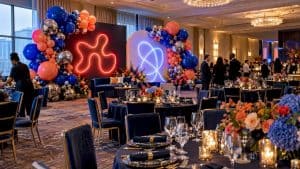
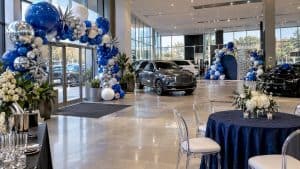
- Branded arches and marquee letters: Anchor a stage or entrance with your company name or a campaign tagline in dimensional letters.
- Photo backdrops: Give attendees a dedicated, styled moment for social-ready photos that carry your brand off-site.
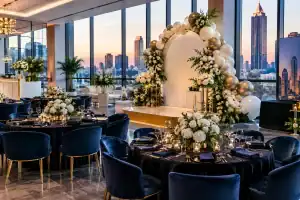
- Luxury table scapes with candles: Elevate a seated dinner or awards reception with layered centerpieces that photograph well under low light.
- Organic garlands and columns: Soften a convention-hall or ballroom feel with texture and color that reads as intentional rather than generic.
A short brief helps us move fast: your event objective, brand colors in Pantone or hex, three must-have photo moments, any lighting constraints, and your venue’s latest room-setup time. Handing that over early saves costly change orders later.
Styled, branded photo moments tend to generate noticeably more social shares than an unstyled corporate backdrop, which is a key reason planners now treat decor as a measurable part of their event strategy rather than an afterthought.
Atlanta-inspired corporate event themes worth stealing
Atlanta’s identity gives planners a head start on theme selection. A Peachtree-inspired palette of soft blush and deep green nods to the city’s nickname without feeling gimmicky, while a Southern hospitality theme built around warm neutrals and brass accents suits a client-appreciation dinner. For tech and startup crowds, a skyline-at-dusk palette of navy, gold, and silver echoes the Midtown and Bucktown skylines and pairs well with marquee letters spelling out a company milestone. Film and entertainment-industry clients, drawn to the city’s production history, often lean into a bold jewel-tone palette with dramatic uplighting. A homegrown “Hotlanta summer” theme with citrus brights works well for outdoor field days and food truck festivals. Each of these themes translates directly into custom balloon designs that carry the color story from entrance arch to table centerpiece, giving the whole event a cohesive, intentional feel rather than a collection of disconnected decisions.
Pairing balloon decor with other Atlanta vendors
Decor rarely stands alone. Catering partners at venues like Zoo Atlanta and many hotel ballrooms often require working within an approved vendor list, so confirm early whether outside catering is permitted or whether you’ll coordinate with an in-house team. For entertainment, DJs, live bands, and interactive activity vendors are widely available across the metro and typically book 60 to 90 days out for peak spring and fall dates. Photo booth operators and videographers pair naturally with a styled backdrop, since the decor becomes the content. Rental companies covering linens, lounge furniture, and staging fill in the gaps around a balloon installation, and many venues maintain a short list of vendors they already know and trust. Coordinating these pieces early, ideally once your venue and decor concept are locked, keeps the day-of setup schedule realistic instead of a race against the clock.
Customizing balloon design to match your brand
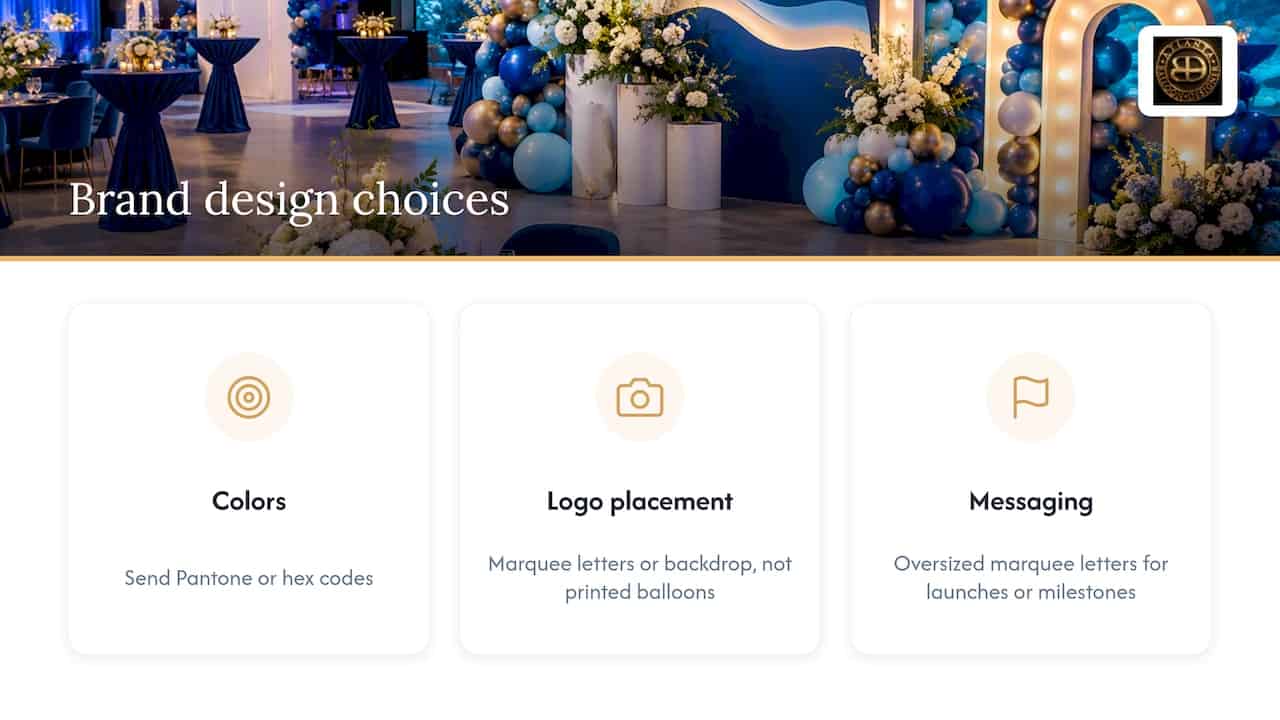
Matching decor to brand identity starts with color accuracy. Send your brand’s Pantone or hex codes rather than a general description like “navy” or “gold,” since balloon stock varies and an exact match protects brand consistency in photos. Logo integration works best through marquee letters, dimensional shapes, or a branded backdrop panel rather than printed balloons, which can look busy at scale. Messaging moments, a product launch name, a milestone number, an anniversary year, read clearest when built as oversized marquee letters rather than crowded into a garland. For companies with a distinct visual identity, mixing metallics like chrome or matte finishes against your core palette adds depth without straying from brand guidelines. The goal is always a design that looks unmistakably like your company’s event, not a generic celebration that happens to be in your brand colors.
Measuring the impact of event decor on attendee perception
Styled decor earns its budget line through a few trackable signals. Social shares and tagged photos from a branded backdrop show up quickly in the days following an event and offer a rough read on how much attendees wanted to be photographed there. Post-event survey questions asking attendees to rate the “overall atmosphere” or “visual experience” separately from content quality isolate how much decor shaped perception. Internal recognition, whether leadership or HR teams mention the event’s look in follow-up communications, is another informal but telling signal. For recurring events, comparing attendance and engagement year over year after investing in styling versus a bare venue setup gives the clearest before-and-after picture. None of these require elaborate tracking tools, just consistent questions asked the same way each time.
Scalable balloon decor packages for every event size
Corporate decor doesn’t need to start at the top tier to make an impact. A single Big Letters installation starts from $50 per letter, enough to spell a company name or milestone at an entrance. A Spiral Balloon Arch or 24 ft Stacked Arch starts from $600, a strong entry point for a branded entrance or stage frame. Stepping up, an Organic Balloon Arch starts from $700, and a Luxury Organic Balloon Arch, built with denser, more dimensional clusters, starts from $1,000. For smaller touches or quick wins, Grab and Go Balloons start from $25 per foot. Delivery, setup, and strike down are quoted separately starting from $125, and a digital mockup to preview your design runs $75. A site visit to confirm measurements and logistics is $250. Mixing and matching these pieces, an arch at the entrance, marquee letters on stage, grab-and-go accents at the bar, lets you scale decor to match your actual budget rather than choosing between one big statement and nothing at all.
What I’ve learned styling Atlanta’s corporate events
The event rooms that stick in people’s memory are rarely the biggest ones. They’re the ones where a single design choice, a color-matched arch framing the stage entrance, a marquee spelling out a milestone, does the work of a dozen smaller decisions. Atlanta corporate planners who build that moment into their timeline early, rather than treating decor as a last-minute add-on, consistently get better photos and a room that photographs like it was designed on purpose.
My practical advice: request a digital mockup before your event, not after your venue walkthrough. Seeing the design against your actual color palette catches mismatches while there’s still time to adjust. If budget allows, add a small arrival activation, even just marquee letters at the entrance, since that first impression shapes how guests describe the whole event afterward. Schedule a consult early and give yourself room to get it right.
— Kay
Ready to style your next Atlanta corporate event
We handle the full arc of corporate decor across Atlanta, from a digital mockup that lets you approve your design before we build anything, to a site visit that confirms every measurement, to install and strike that leaves your venue exactly as we found it.
Our pricing and package details cover everything from a single marquee letter to a full stage transformation, and our services page outlines corporate packages alongside add-ons like photo backdrops and party rentals. If your event includes guest transportation, partners like branded shuttle staging guidance can help coordinate arrivals smoothly alongside your decor timeline.
Reach us at 678.203.0200 or request a quote through our site to start with a digital mockup and a date on our calendar.
FAQ
What are some good corporate event venues in Atlanta, GA?
Strong options span five categories: attractions like the Georgia Aquarium and Zoo Atlanta, the Georgia World Congress Center for large-scale conventions, hotel ballrooms for full-service convenience, parks for outdoor flexibility, and entertainment campuses like Battery Atlanta for mixed meeting-and-social days. The right choice depends on your headcount and whether you want a built-in activity layer or a blank canvas.
Is $90,000 a good salary in Atlanta?
This question falls outside what we can speak to as an event styling company, since it depends on individual circumstances, household size, and cost-of-living factors we’re not positioned to assess. For planning budgets, our guidance focuses on event costs like venue, catering, and decor rather than personal salary benchmarks.
What are some corporate events?
Common formats include team-building days, award ceremonies, product launches, holiday parties, client appreciation events, and networking receptions. Atlanta planners can build any of these around outdoor, attraction-based, competitive, culinary, or hybrid formats depending on group size and season.
What is the next big event in Atlanta?
Atlanta’s calendar shifts year to year with convention schedules, sports seasons, and citywide festivals, so the most current information comes directly from venues like the Georgia World Congress Center or local tourism resources rather than a fixed answer. Checking venue and convention-center calendars directly gives planners the most reliable view of upcoming dates that might affect availability or pricing.