An event load-in plan is one written schedule that tells every supplier when they arrive, where they unload, what must be finished before they start and who signs them off. The plans that survive show day start from the venue’s access window, work backward from the minute doors open, and put each vendor in an order set by dependencies, not by whose truck shows up first. Below is how to build one, with Atlanta venue rules you can check against. We style corporate events, grand openings and luxury celebrations across metro Atlanta, so we plan our own arrivals around these same constraints.
TL;DR
- Get the venue’s access rules in writing first: earliest access, latest clear time, entrance, dock and elevator limits, floor and fixing rules.
- Work backward from doors. If the vendors’ setup times add up to more than the window, change the plan now, not on the day.
- Sequence by dependency: structures, staging and power first, then furniture and linens, then décor and styling, and last the fragile finishing items.
- Give every row one named owner, one arrival slot and one sign-off, and send the schedule a week out and again two days out.
- Map teardown as its own chain. The out-by time is as hard as the doors time.
Table of Contents
- What a load-in plan actually contains
- Start with the venue’s written access rules
- Atlanta venues: what the written rules actually say
- Build the schedule backward from doors
- Sequence vendors by dependency, not by arrival
- An illustrative load-in schedule with décor in it
- What décor vendors and planners need to coordinate
- Communication, ownership and safety checks
- Do not forget load-out
- Where we can take work off your plate
- Our perspective
- FAQ
- Sources
What a load-in plan actually contains
Load-in covers everything from the first supplier arriving to the moment the room is ready for guests: deliveries, unloading, building, styling, testing and clearing packaging. The plan has two parts.
Part one is the venue’s rules. These are the earliest access time, the latest time the room must be clear, which entrance to use, how many trucks the dock holds at once, lift dimensions, and any limits on noise, floor protection and fixings. Add overtime charges, because a plan that runs over the window can cost more than it looks.
Part two is a supplier table. Each row shows who is arriving, vehicle size, crew count, arrival slot, entrance, unload and parking location, an on-site contact, setup time, finish time and what must already be in place before that crew can start. That last column does the most work. It is what decides your order.
A schedule that lists only start times is a wish list. A working one shows which tasks cannot begin until another is signed off, who owns each gate and how much buffer sits between them.
Start with the venue’s written access rules
Planners often build the schedule around what suppliers prefer and then learn the building will not allow it. Reverse that. The venue controls both the load-in and the load-out window, so its rules go in first.
Ask the venue’s operations or engineering contact to confirm these in writing:
- The access window. The loading door and the room release can be different times. Get both in writing, along with the dock and elevator reservation rules.
- Dock and vehicle limits. Dock height, number of bays, what happens if a slot is bumped, and restrictions on vehicle clearance, weight and turning radius.
- Freight elevator details. Interior size, weight limit, whether an operator is required, and how to call it. Dock and elevator specifications should also include door width and height for your largest item.
- The route. The narrowest door, the tightest corner and any fire-separation doors between dock and room.
- Floor protection and house labor. Some buildings require protection under equipment and some require house crews for certain tasks.
- Insurance and house rules. Many venues ask vendors for a certificate of insurance before they release a dock slot.
- Other vendors’ schedules. Ask for the written order of who goes first so you are not guessing.
- Strike. The time removal starts, the removal deadline and the dock release time.
A nine-point access list from a venue-logistics team adds two more worth asking: overnight or hold access, and egress and fire-lane preservation. Both matter if your build runs long or your displays sit near exits.
For décor in particular, ask about ceiling, wall and floor fixing rules before design is final. Our guide to five questions about balloon décor venue restrictions covers what to raise, and our venue coordination guide for planners goes deeper on the handoff between venue and decorator.
Atlanta venues: what the written rules actually say
Venue rules differ more than most first-time planners expect. Four Atlanta-area examples show the range. Always confirm against the current version, since these documents get updated.
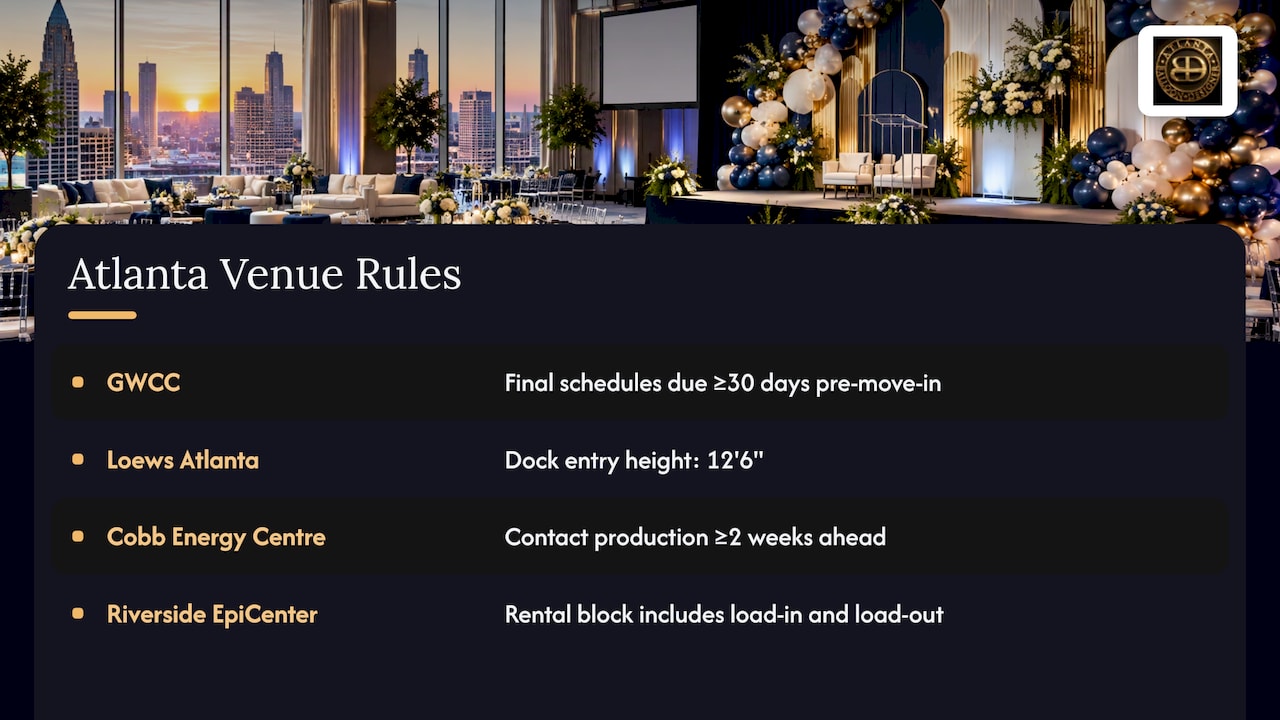
Georgia World Congress Center (GWCC). The center’s planning guide asks for a final full event schedule, final exhibit hall plans including storage and vehicles on display, and a detailed production schedule covering AV and rigging, at least 30 days before first move-in. Any structure built or brought in must be listed on that schedule. Its more recent guide states that drilling and anchoring are prohibited campus-wide, freight is not permitted on passenger elevators, and that activations and structures must appear on floor plans and be approved by a Fire Marshal. The same guide gives floor load ratings of 350 lbs per square foot in Buildings A and B and 400 in Building C and BC Hall, which matters for heavy displays.
Loews Atlanta Hotel. The hotel’s loading dock entrance is on Juniper Street between 12th and 11th Streets, and vendors sign in with security for a pass. According to the hotel’s dock instructions, the dock entry height limit is 12’6", two freight elevators serve the C-level ballroom area, and the self-parking garage limit is 6’7". A van that clears the garage may not be a box truck that clears the dock, so vehicle size belongs in your supplier table.
Cobb Energy Performing Arts Centre. Its technical package asks presenters to contact production staff at least two weeks before the first day with a full schedule, outside vendor and truck details and rigging plans. All show personnel sign in at the Stage Door for an ID, and no equipment arrives before the scheduled load-in without the Technical Director’s approval. Note the document date on the page and confirm nothing has changed.
Riverside EpiCenter in Austell. The venue’s policies say the contracted time block includes load-in and load-out, that the lessee completes an arrival inspection before setup and a departure inspection for deposit return, and that all load-in and load-out goes through the loading dock. That means every minute of your build comes out of the time you paid for. We are based in Austell ourselves, so we know how tight a rented block can feel when styling is the last thing to go in.
The pattern: big venues want paperwork a month out, hotels control the dock by pass and height, and smaller venues bundle setup into your rental hours. Your plan needs to answer all three.
Build the schedule backward from doors
The most dependable method is simple. Take the moment doors open and subtract, in reverse order, everything that must be finished before it. Whatever time is left over is the access window the venue has to give you. If the venue’s window is shorter than the total, change the plan now: an earlier access time, a different vendor or a simpler setup.
The working steps:
- Lock the hard deadlines. Doors time, the venue’s latest clear time, the fire marshal walk-through if one is required, and any inspection or power-on time the venue sets. Separate these from preferred finish times, which can flex.
- Subtract the final checks. Leave a walkthrough, a line check or rehearsal if you have programming, and a last room reset for guests. One sample plan for a 200-guest ballroom with 6:30 p.m. doors leaves a 5:00 p.m. line check, a 5:30 p.m. rehearsal buffer and a 6:15 p.m. room reset, which works out to about 75 minutes between line check and doors.
- Place each vendor by what they need first. A sound system needs unloaded, powered gear; unloading needs a free bay and a person to receive the truck. Write each task’s practical start condition instead of assuming the scheduled time makes it true.
- Add buffers where uncertainty lives. Complex access, custom scenic pieces and multi-supplier work deserve more headroom than a single delivery to a ground-floor room.
- Set a freeze. Decide a time, such as 30 minutes before doors, after which no new tasks start.
There is no universal number of hours before doors. The right start time depends on the task list, venue rules, any union or vendor jurisdictions and equipment access.
Sequence vendors by dependency, not by arrival
Bottlenecks come from vendors who need the same dock, the same floor space or the same power at the same time. Three ideas fix most of them.
Structure first, delicate last. The long-standing rule is big and dirty before small and delicate. Staging, rigging and lighting go in first because they need ladders, noise and open floor. Furniture follows, then linens and tableware, then catering setup, then florals and styling. Easily damaged finishing items such as signage, cake and favors go in last. Production teams describe the same logic for show builds: staging and rigging load in first, then audio, lighting and video, and rigging points are checked before any other department works overhead.
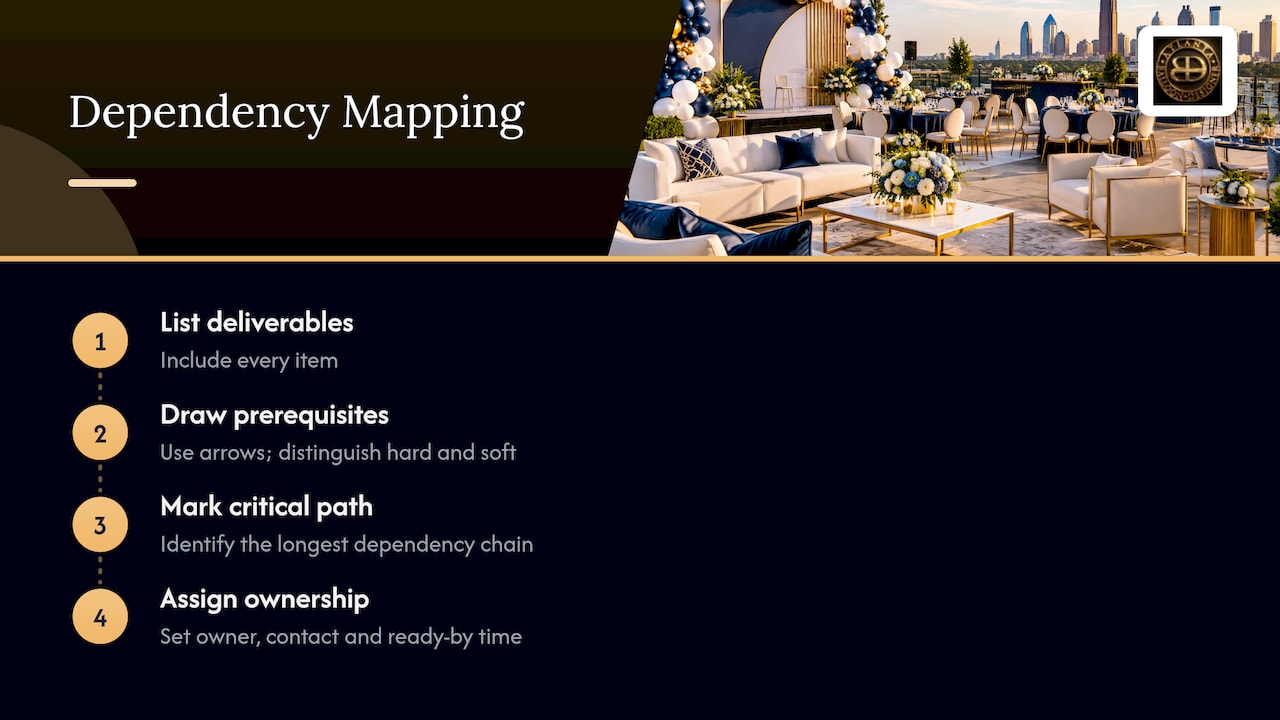
Separate hard dependencies from soft ones. A stage deck must exist before lighting focus, and power before soundcheck. Those are hard. Décor before catering is soft. When you fall behind, protect the hard dependencies and compress the soft ones. Mapping it takes four moves: list every deliverable, draw the prerequisite arrows, mark the longest chain as the critical path, and give each item one owner, one contact and one ready-by time.
Stagger the docks. One worked example: with two dock bays and four vendors who each need about 45 minutes, moving the second pair’s arrival from 10:00 to 10:45 keeps the same 11:30 finish and removes 45 minutes of curb idling. Trucks should unload in the order of the build, and cases should move to staging instead of piling up at the dock, with one person controlling truck access.
Guest-facing transport follows the same logic. If you are running guest rides to the venue, keep their drop-off times and curb space apart from the vendor dock window; this guide to planning guest shuttle rides shows how to schedule pickups in a practical order with clear readiness points.
For a deeper look at who belongs on the vendor roster in the first place, see our event décor vendor guide for planners.
An illustrative load-in schedule with décor in it
The table below is a worked example we built for planning purposes, not a real event. It adapts the backward-from-doors structure for a 200-guest hotel ballroom with doors at 6:30 p.m. and a branded entrance and balloon backdrop. Your times will move with your venue’s window.
| Time | Task | Owner | Sign-off before next step |
|---|---|---|---|
| 7:00 a.m. | Dock release, vendor passes issued | Venue contact | Passes issued, dock clear |
| 7:15 a.m. | Staging and truss delivery unloaded | Production lead | Cases moved to staging area |
| 8:30 a.m. | Staging and rigging build | AV vendor | Rigging inspected |
| 11:00 a.m. | LED wall and power runs | AV vendor | Power confirmed on |
| 1:00 p.m. | Lunch; hard stop for loud work | Planner | Room quiet |
| 1:30 p.m. | Furniture and linens laid | Rental company | Tables placed, linens on |
| 3:00 p.m. | Lighting focus | AV vendor | Focus complete |
| 3:30 p.m. | Décor delivery, backdrop and entrance styling | Décor vendor | Install photographed and approved |
| 4:30 p.m. | Signage, favors, final fragile items | Planner | Signage placed |
| 5:00 p.m. | Line check and walkthrough | Production lead | Walkthrough complete |
| 5:30 p.m. | Buffer, freeze on new tasks | Planner | Punch list cleared |
| 6:15 p.m. | Room reset, packaging cleared | Venue contact | Room guest-ready |
| 6:30 p.m. | Doors | Planner | n/a |
Two things to notice. The décor slot sits after linens are down and before the final checks, so a stylist is never working around a lighting crew’s ladders. And every row has one owner and a physical condition for “done.”
What décor vendors and planners need to coordinate
Branded entrances, photo backdrops and balloon installations look like the lightest items on the schedule, which is exactly why they get squeezed. A few points keep them from being the casualty of a late dock.
- Give the décor vendor an exact slot. Tell them the room, the wall or corner, the arrival window, the door to use and who meets them. Large deliveries should be staggered 30 to 60 minutes apart.
- Tell them what must be in place. A stylist usually needs tables laid and linen down before centerpieces go on, and an installation area free of ladders and active lifts.
- List the structure. At convention-scale venues, anything built or brought in has to be on the event schedule and the floor plan, as the GWCC rules above show.
- Confirm the fixing rules early. If the venue forbids drilling or hanging from certain surfaces, the design needs to be freestanding or supported another way before the mockup is approved.
- Photograph and sign off. A time-stamped photo of the finished install doubles as the sign-off record and protects everyone if timing is disputed later.
This is where working with a decorator who handles the whole pass pays off. We deliver, set up and strike down our installations, and delivery, setup and strike down starts at $125. If the venue’s layout is unclear, we offer site visits at $250, so your load-in row for décor is based on the real route from dock to room. And if you want to see the design before a single truck is booked, a digital mockup is $75 per mockup. Arches start at $600 for a spiral or 24 ft stacked arch, $700 for an organic arch and $1,000 for a luxury organic arch. Our conference entrance décor ideas show how these pieces sit in a real arrival flow.
Communication, ownership and safety checks
One owner for the master schedule. One person, not a committee, owns the master schedule and resolves dock conflicts before event week, not at the door. Vendors who can see where they sit on the critical path tend to arrive early instead of merely on time.
Send the packet twice. A week before the event, send every supplier the exact address and entrance, load-in start and end times, parking instructions, a named point of contact, the setup location (room, corner, wall), power needs, the load-out deadline and insurance requirements. Two days before, send a reminder and ask each vendor to reply with an arrival time and the name of their on-site lead. For venues with formal requirements, such as the two-week and 30-day windows above, send earlier.
Get written confirmation. Before trucks are dispatched, have vendors confirm in writing that their crew size and timing fit the sequence. Specialized work such as rigging, electrical and powered lifts belongs to qualified, authorized people, and the venue’s safety staff decide whether it is ready. General setup staff should not be assigned to it.
Check before you open. After setup, walk the room. Recheck exits and accessible routes, loading areas, cords, surfaces and equipment, and test radios and phones. If a hazard cannot be fixed before opening, isolate it, change the layout, delay the activity or hold opening until it is safe. Doors do not open on a hazard.
Plan for slippage. Decide in advance what you will cut if the build runs 45 minutes late. Compress the soft dependencies, such as a secondary display or favors, and protect the hard ones. Name who makes that call.
Do not forget load-out
Teardown has its own chain: gear strike, cable pull, floor check, venue walkthrough and deposit return. Map it separately, or you lose the out-by window. Write the strike start time, the removal deadline and the dock release time into the same document. At venues like Riverside EpiCenter, a departure inspection sits between you and your deposit, so leave time for it after the last case is gone.
For décor, set the removal order too. Installations that came in last usually come out first once guests leave, so the dock is clear for rented items and AV. Tell the venue contact which items will leave early and which will wait for the end of the night.
Where we can take work off your plate
If your event is in metro Atlanta, from Buckhead, Midtown and Sandy Springs to Marietta, Austell and Lithia Springs, we can take the décor row off your schedule. We handle corporate event balloon décor, grand opening and business event balloons and backdrops, and for private hosts, luxury event styling, baby showers and birthday styling. Our team serves Atlanta and surrounding communities within a 60-mile radius. Send us your venue, your access window and your doors time, and we will fit our arrival into your plan. Call 678.203.0200 or visit Atlanta Balloon Designer.

Our perspective
A load-in plan is a design decision as much as a logistics one. When a client sends us a venue and a doors time, the first thing we want to know is how our pieces get from the dock to the room, because that route shapes what we can build. A grand arch that looks stunning on a mockup still has to fit through the narrowest door.
We believe the best events feel effortless because the plan was boring: one owner, one schedule, one arrival slot for each vendor. That is why we put so much weight on the mockup and the site visit. Seeing the design and the space before the day lets every other vendor plan around real dimensions.
Our work is delivered, set up and struck down by our own team, and we want a place in your schedule that is clear and unhurried, so the installation is camera-ready when your first guest walks in.
Kay
FAQ
How far ahead should I send the load-in schedule to vendors?
Send it at least a week before the event and again two days before, asking each vendor to confirm their arrival time and on-site lead. Large venues can require much more notice: GWCC asks for production schedules 30 days before first move-in, and Cobb Energy Performing Arts Centre asks presenters to contact production staff two weeks ahead.
What is the difference between load-in and setup?
Load-in is the whole arrival phase: deliveries, unloading, moving items to the room and clearing packaging. Setup is the building and styling that happens once items reach the room. A good plan schedules both, since a vendor can be on site and still blocked by a dock or room that has not been released.
How much buffer should a load-in schedule have?
There is no single number, but a common pattern is 10 to 15 minutes at transitions between tasks, a longer buffer before final checks, and a freeze on new tasks about 30 minutes before doors. Add more headroom around complex access, custom pieces and multi-vendor work.
Who should own the load-in plan?
One named person: the planner, production manager or venue-facing lead. That person resolves dock conflicts, holds the master schedule and decides what gets cut if the build runs late. Every other row gets its own owner, so a missed gate is traceable.
When should the décor vendor arrive?
After structures, staging, power and furniture are in, and once tables are laid, but before final checks and the freeze. Ask your venue for the written vendor order, then give the décor team an exact slot, door and contact.
Sources
- Event AV Load-In Schedule: Hour-by-Hour Setup Day Plan
- Event Load-In: Understanding the Setup Process
- Optimize Your Event Timeline with Loading Dock Insights
- GWCC Event Planning Guide (2024)
- GWCC Event Planning Guide (2026)
- Loews Atlanta Hotel loading dock instructions
- Cobb Energy Performing Arts Centre technical package
- Riverside EpiCenter venue policies
- Event Load-In Checklist by Department
- How Do You Coordinate Multiple Event Vendors?
- Wedding Venue Load-In Restrictions: Dock and Scheduling
- Concert Load-In: Coordinating Stage, Sound, Lighting and Crew
- Event Safety Legal Guide for Staff Managers