A corporate event budget can disappear fast when every stakeholder wants something memorable. The smart question is not whether decor belongs in the plan. It is how to budget corporate decor so the room feels intentional, branded, and camera-ready without spreading dollars across details no one will notice.
For a product launch, company celebration, grand opening, gala, or employee appreciation event, decor is not just a finishing touch. It shapes the arrival moment, the photo content, the energy in the room, and the perception of the brand hosting it. The goal is to invest where visual impact is highest, then build the rest of the design around those moments.
Start With the Event’s One Big Job
Every event has a primary purpose. A grand opening needs to stop traffic and create a clear “we are here” moment. A recruiting event needs to make company culture feel exciting. A conference may need branded environments that work across several days of programming. A holiday party may be all about giving employees an experience that feels like a true reward.
Before pricing balloon installations, backdrops, florals, rentals, or entertainment, write down the event’s one big job in a single sentence. Then ask what guests must see, feel, or share to make that job happen.
That answer should guide the decor budget. If your priority is social visibility, a statement photo backdrop and branded entry installation may deserve more funding than tablescape upgrades. If the goal is a polished executive dinner, lighting, centerpieces, and refined place settings may matter more than a large-scale balloon moment. Both approaches can be high-impact. They simply serve different outcomes.
Set a Decor Number Before You Shop
The fastest way to lose control of spend is to request ideas before establishing a range. A creative partner can design at many levels, but they need a realistic investment target to recommend the right scale, materials, and installation approach.
Start with the total event budget, then reserve the non-negotiable costs first: venue, food and beverage, audiovisual, staffing, entertainment, transportation, and permits or security where required. From there, assign a decor allocation based on how central the visual environment is to the event.
For a straightforward office celebration, decor may be a smaller slice of the full budget. For a media event, branded activation, retail opening, or sponsor-facing experience, decor often deserves a stronger allocation because it directly supports visibility and content capture. There is no universal percentage that fits every event. A 40-person leadership reception and a 500-guest brand launch should not be budgeted the same way.
Give your decor partner a working range rather than a single fixed number. For example, tell them you are targeting a polished design in a defined range, with room to expand if a particular feature creates a meaningful marketing return. That opens the door to smart options instead of a proposal that misses the mark in either direction.
Spend First on High-Visibility Zones
Not every square foot needs custom treatment. Luxury event design is about control, focus, and proportion. A few strong moments will usually outperform a room filled with scattered small purchases.
Prioritize the spaces guests encounter most and the areas that will appear in photos, video, and social content:
- The exterior approach or entrance, especially for grand openings, ribbon cuttings, and VIP arrivals
- Registration, check-in, or welcome areas where every attendee pauses
- The stage, presentation area, or main focal wall
- A branded photo moment that invites guests to interact and share
- The bar, dessert display, or another natural gathering point
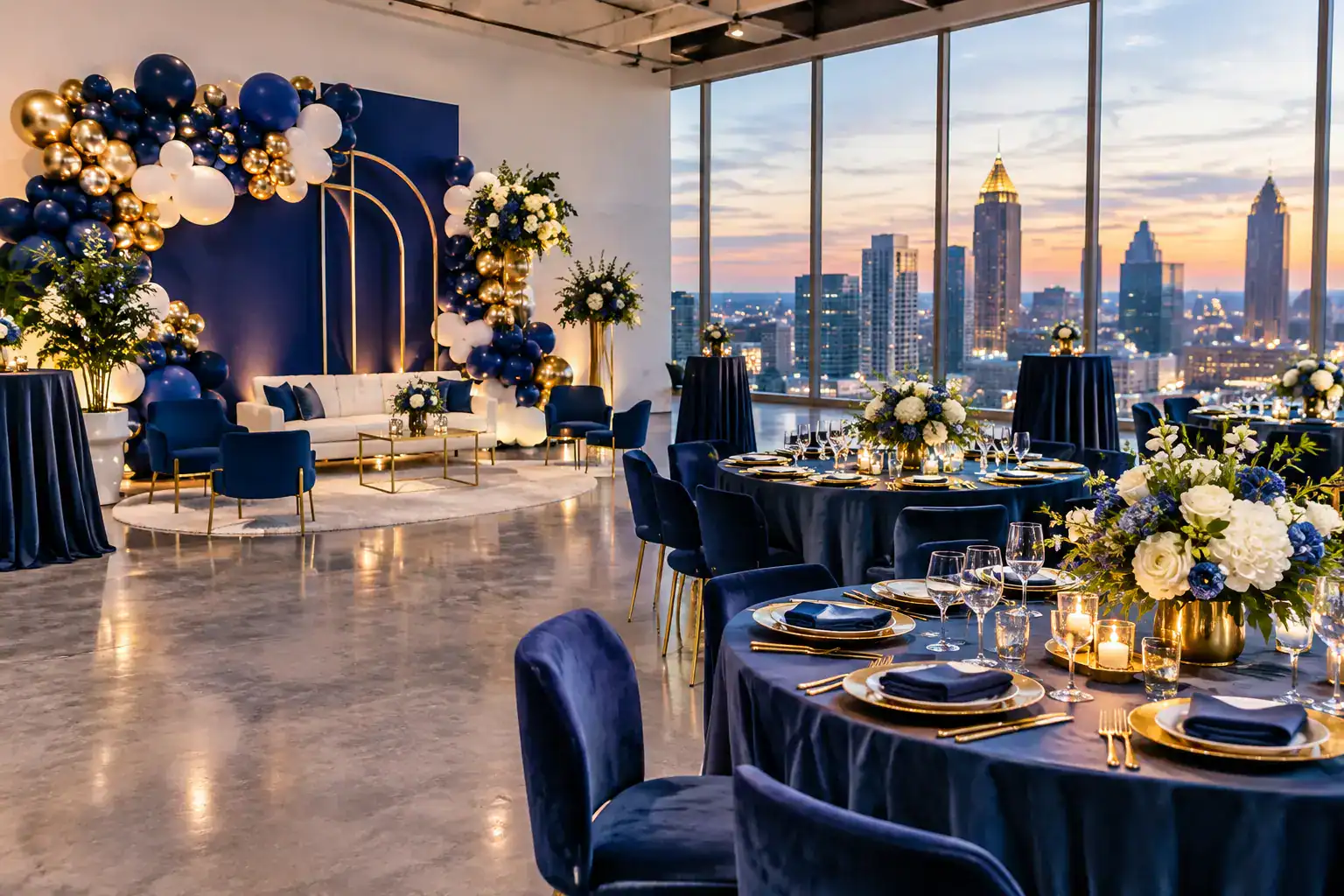
A dramatic organic balloon installation framing a branded backdrop can deliver more value than several small centerpieces placed across a large room. The same is true of custom marquee letters, a refined floral focal point, or a designed lounge vignette. The strongest investment is often the element that appears in hundreds of guest photos rather than the detail seen only by the people sitting closest to it.
Build a Tiered Decor Plan
A tiered plan keeps decisions strategic when budgets tighten. Instead of asking, “What can we cut?” decide what belongs in the must-have, high-value, and optional categories.
Your must-have tier includes the visual pieces required to make the event recognizable and cohesive. Think brand colors, a focal moment, and a welcoming arrival experience. The high-value tier includes enhancements that improve guest flow or content creation, such as a custom photo wall, coordinated table decor, rental furniture, or a branded display.
The optional tier is where extra drama lives: additional installations, upgraded florals, specialty props, entertainment activations, and design moments in secondary rooms. These are not unimportant. They are simply easier to scale once the essential experience is protected.
This framework also makes internal approval easier. An executive team may approve the core design immediately, then release funds for the optional tier once guest count, sponsorship, or marketing needs are confirmed.
Know What Actually Drives Decor Costs
Corporate decor pricing is not based on pretty pictures alone. Two designs that look similar online can require very different levels of labor, materials, equipment, and logistics.
Scale is a major factor. A compact balloon garland for a lobby is different from an installation that wraps a multi-story entry, frames a stage, or spans a trade show footprint. Custom work also costs more than off-the-shelf styling because it requires design planning, specialized materials, fabrication, and installation time.
Venue conditions matter just as much. A hotel ballroom with easy load-in has different requirements than a rooftop, stadium, retail storefront, outdoor plaza, or convention center. Ceiling height, access points, parking, elevator size, loading dock rules, installation windows, and strike deadlines can all affect the final investment.
Do not overlook brand requirements. Exact logo reproduction, custom color matching, printed panels, dimensional signage, or a tailored photo backdrop may require additional production time. Those details can be worth every dollar for a public-facing event, but they should be planned early rather than treated as a last-minute add-on.
Protect the Budget From Last-Minute Changes
Late changes are where polished plans become expensive plans. Once a design is approved, changes to guest count, venue layout, event timing, or brand direction can affect labor, rentals, and materials.
Lock in the venue floor plan as early as possible. Confirm whether the event is indoors or outdoors, where power is available, which doors can be used for load-in, and when installers can access the space. If the event includes a step and repeat, photo booth, DJ, or live entertainment, map those pieces together so one activation does not block another.
It is also wise to reserve a contingency line in the decor budget. For large events, this can cover a venue-required adjustment, weather protection for an outdoor activation, a last-minute branding need, or an enhancement that becomes necessary once the full production comes together. A contingency is not wasted money. It is what keeps a great design from being compromised by a surprise.
Choose Flexible Design Elements
When value matters, select decor that can work harder than once. A branded backdrop can serve as a welcome wall, press moment, and photo opportunity. A balloon installation can frame a stage during programming, then remain in place for networking photos. Lounge furniture can create a VIP area early in the evening and a social hub later.
Color is another powerful budget tool. A strong palette can make a space feel fully transformed even when the design is intentionally edited. Pairing brand colors with elevated neutrals, chrome accents, or a dramatic tonal palette often creates a premium result without requiring custom treatment on every surface.
For recurring events, ask for elements that can be adapted instead of rebuilt from scratch. Modular backdrop structures, reusable signage bases, and rental inventory can lower costs over time while keeping each event fresh through new graphics, balloons, florals, and lighting.
Treat Photography as Part of the Return
A corporate decor investment should be measured beyond the event date. The right design gives your marketing team employee-generated content, event recap images, sponsor visibility, recruiting assets, and visuals for future promotions.
That is why a photo moment should not be an afterthought squeezed into an unused corner. Place it where guests can find it, light it properly, and make the branding visible without overwhelming the image. If guests naturally want to stand in front of it, your decor is doing its job.
For Atlanta corporate teams planning an activation, Atlanta Balloon Designer can help translate a working budget into a bold, polished visual plan built for the venue, audience, and brand moment at hand. A clear brief, early venue details, and a realistic range make the creative process faster and far more effective.
The best corporate decor budget is not the one that buys the most pieces. It is the one that creates a few unforgettable moments, supports the purpose of the event, and leaves guests with photos they are genuinely excited to share.