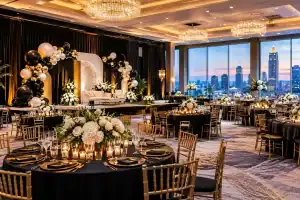
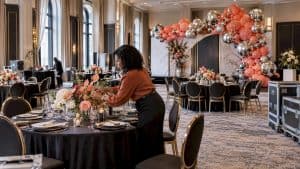
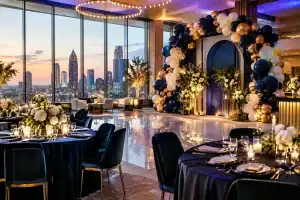
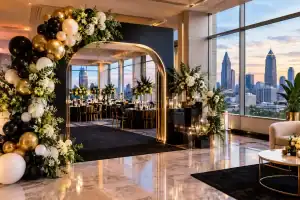
Pipe and drape is the right tool when you need to divide, hide or frame a space. A standalone backdrop is the right tool when you need one striking focal point that guests walk toward, pose in front of and remember. Most Atlanta corporate events, grand openings, baby showers and first birthdays need the second job more than the first, and the best rooms often combine the two: neutral drape to clean up the space, a designed backdrop to give it a heart.
This guide shows how the two differ, where each one shines, what to check with your venue before you order either, and how to budget. If you are planning in Atlanta, Marietta, Sandy Springs, Buckhead, Midtown or anywhere within about 60 miles of Austell, we have built the decision around the way those events actually run.
TL;DR
- Pipe and drape is a freestanding frame of uprights, crossbars and fabric panels. It is built to separate zones, hide walls and clutter, and define booths and stages.
- A standalone backdrop (balloon installation, fabric, printed or LED wall) is built to be looked at and photographed. It is the focal point, not the wall.
- Choose pipe and drape for structure and privacy; choose a backdrop for photos, branding and the moment guests remember. Choose both when the room needs cleaning up and finishing.
- Any fabric used in a public venue usually has to be flame resistant, so ask the venue what paperwork it wants before you commit.
- Our published pricing for arches starts at $600, with delivery, setup and strike down from $125.
Table of Contents
- What Pipe and Drape Actually Is
- What a Standalone Backdrop Is
- Pipe and Drape vs. Backdrop at a Glance
- When Pipe and Drape Is the Right Call
- When a Standalone Backdrop Wins
- Which One for Which Event
- Fire Rules and Venue Requirements
- Sizing the Space
- What It Costs
- Using Both Together
- An Atlanta Planning Checklist
- Work With Atlanta Balloon Designer
- Our Perspective
- FAQ
- Sources
What Pipe and Drape Actually Is
Pipe and drape is a freestanding paneling system. Vertical uprights stand on weighted bases, horizontal crossbars span between them, and fabric hangs from the crossbars like a curtain. Event professionals use it to temporarily divide, hide or decorate a space, most commonly in trade show booths, tents, banquet halls and on stage.
That is the key idea: it is a system, and its main job is architectural. It makes a wall where there is no wall. It hides a service door, a loading dock, a bare cinderblock corner or the back of a stage. It creates a registration zone inside a ballroom, or a booth line inside an exhibit hall. Because the parts are modular, you can lengthen a run, add a corner or change the height without starting over.
The fabric does the visual work, but in most uses it is meant to disappear into the background. Black, ivory and navy are the usual choices because they quiet a space instead of competing with it.
What a Standalone Backdrop Is
A backdrop is a designed scene behind a person, a podium, a table or a photo moment. It can be a balloon installation, an organic arch, a garland wall, a fabric or vinyl panel, a printed step-and-repeat banner, or an LED screen. Its job is not to hide the room. Its job is to make a spot in the room worth stopping at.
Backdrops come in a wide range:
- Balloon backdrops and arches, from clean spirals to organic, layered designs with metallics, chrome and florals. Our guide to what a balloon backdrop is and how it is set up walks through the options.
- Fabric and vinyl panels, which we compare in fabric vs. vinyl backdrops.
- Press walls and step-and-repeat banners for logos and sponsor photos, covered in press wall vs. step and repeat.
- LED walls for motion and live content, which we weigh up in LED wall vs. backdrop.
A backdrop is the thing that ends up in the photos, on the social posts and in the memory of the evening.
Pipe and Drape vs. Backdrop at a Glance
| Pipe and drape | Standalone backdrop | |
|---|---|---|
| Main job | Divide, hide, define space | Create a focal point and photo moment |
| Typical look | Clean, uniform, neutral | Designed, branded, themed |
| Best at | Booths, stages, room dividers, hiding walls | Photo ops, step-and-repeat, grand openings, ceremonies, dessert tables |
| Scale | Long runs of wall | One defined feature, from table-size to room-filling |
| Flexibility | Modular, can be extended or reshaped | Custom to the event and theme |
| What guests remember | The room felt tidy and organized | The moment they stood in front of it |
| Customization | Fabric color and height | Colors, textures, florals, lettering, logos, lighting |
Neither is better in the abstract. They answer different questions, and the confusion starts when people ask a backdrop to be a wall or a wall to be a showpiece.
When Pipe and Drape Is the Right Call
You need to hide or separate something
If a room has an ugly wall, a visible service corridor, exposed equipment or a doorway you do not want guests drifting through, drape solves it quickly and neatly. It is also how event teams create a back-of-house area for catering, coat check or storage inside an open ballroom.
You are building booths or zones
Trade shows and expos are the home territory of pipe and drape. A booth needs a back wall and side walls so exhibitors have a defined footprint, and the same logic works for a corporate registration area, a sponsor lounge or a breakout space in a hotel meeting room.
You need a stage surround
A tall drape behind a speaker or head table gives a clean, uniform field of color. It keeps the eye on the person rather than the room behind them, and it photographs calmly. Heavier fabrics also take the edge off echo in a hard-walled space.
The room is large and plain
Hotel ballrooms and convention halls often have a lot of floor and not much character. Drape lowers the visual height and softens the edges so a big room feels intentional. One thing to keep in mind: long straight runs can look flat on their own. That is where a designed feature earns its place.
When a Standalone Backdrop Wins
Photos are part of the plan
If you want guests to take pictures, give them a place to take them. A plain drape behind a podium photographs as a plain drape. A well-built installation behind the same podium photographs like an event. We cover why in the role of backdrops in photography and in our overview of photo op backdrop types.
The event has a brand or a theme to show
A product launch, a grand opening, a sponsor night or a company anniversary needs colors, logos and a look that guests link to the brand. Drape cannot carry that by itself. A backdrop can: brand colors in balloons, dimensional letters, a logo wall, florals or lighting. See how that plays out in conference photo backdrop balloons.
It is a celebration
Baby showers, first birthdays, graduations, bridal showers and milestone parties are about the moment, not the partitioning. A focal arch, a garland wall, marquee letters or a themed scene behind the dessert table does more for the room than any amount of fabric. Families who want that kind of look can start with our guide to designing luxury baby showers.
The space is already good-looking
A historic home, a rooftop, a restaurant with great finishes or a garden does not need to be hidden. It needs one feature that works with it. A backdrop adds that accent without covering what is already beautiful.
You want the focal point to be an experience
Immersive installations, balloon ceilings and layered arches are designed to be walked through, not just looked at. For ideas on going overhead, see our pieces on wedding balloon ceilings and ceiling decor ideas.
Which One for Which Event
| Event | Lead with | Why |
|---|---|---|
| Trade show booth or expo | Pipe and drape, plus a branded feature | Booth walls define the footprint; a feature draws traffic |
| Corporate conference stage | Drape surround, plus a designed backdrop at the photo area | Calm stage, memorable sponsor photos |
| Grand opening | Standalone backdrop | The ribbon-cutting photo is the moment |
| Corporate gala or holiday party | Backdrop, with drape where walls need hiding | Guests arrive to a showpiece, not a partition |
| Luxury baby shower | Backdrop | Theme, color and photography are the point |
| First birthday | Backdrop | A themed scene for the cake table and family photos |
| Wedding ceremony | Either, or both | Drape for a clean frame, a floral or balloon feature for impact |
| Hotel ballroom with bare walls | Both | Drape to tidy, backdrop to finish |
For corporate planners especially, the question is rarely either-or. Ask what the room needs (structure, a feature, or both), then budget for each need.
Fire Rules and Venue Requirements
This is the part that surprises first-time planners. Fabric in a public venue is a fire-safety matter. NFPA 701 is the national standard for flame resistance of textiles and films used in public assembly spaces, and large convention venues generally require drapes, table covers and similar materials to be flame resistant, with paperwork to show it and inspection by the fire marshal. Some materials, such as plastic cloths, cannot be treated and are commonly prohibited.
What that means in practice:
- Ask the venue first. Hotels, convention centers, churches, schools and city-owned halls each have their own rules. Ask what they require for fabric, balloons, hanging elements and anything near exits, sprinklers or fire equipment.
- Request certificates for fabric. Whoever supplies drape or fabric panels should be able to provide documentation of flame resistance.
- Keep exits and sightlines clear. Whatever you build, it should not block exit signs, fire doors or aisles.
- Plan for stability. Freestanding structures, tall ones especially, need proper bases and weight, and extra care wherever guests brush past, such as aisles and doorways.
Give your venue coordinator a sketch or a digital mockup early, so approval is not a day-before surprise. We offer a digital mockup for $75 per mockup, which gives venue managers and corporate stakeholders something concrete to approve.
Sizing the Space
Both options start with the same question: how much room do you have, and what has to happen in it?
For pipe and drape, size is a function of wall length and height. Systems are built from sections, and a run of connected sections shares uprights, so the count of uprights is one more than the count of sections. Heights are chosen to match the job: lower for skirting and booth side walls, taller for dividers and stages. Fabric is cut with fullness, meaning extra width so it folds into pleats instead of hanging flat. Fuller drape looks richer and costs more fabric.
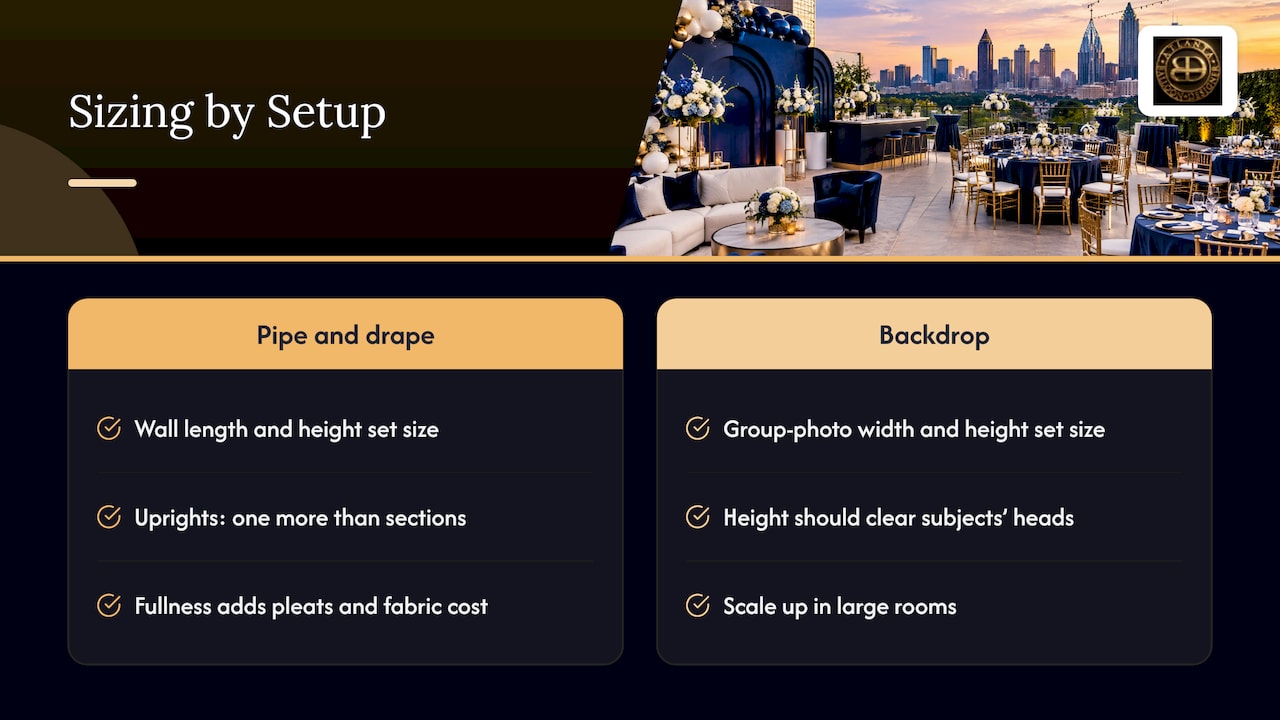
For a backdrop, size is a function of the photo and the crowd. A backdrop should be wide enough for the group that will pose, and tall enough that it does not end at the subject’s head. For large rooms, scale up rather than add more small pieces. Our guide to balloon arch types shows how arch shapes and sizes change the effect.
If your program includes live performers, from stilt walkers to roaming acts, plan the footprint around them as well. There are useful rules of thumb for matching room size to a performance, and the same thinking applies to how much floor your backdrop and drape take up.
A site visit settles all of this faster than any formula. Ours is $250 and lets us measure ceilings, check load-in routes and see where light falls before anything is built.
What It Costs
Pipe and drape is usually priced by the section or linear foot, plus fabric type, height, labor and delivery. A backdrop is priced by design: size, materials, complexity and installation time. Because they are priced on different logic, compare them by what each delivers, not by sticker price alone.
For the backdrop side, here are our published starting prices:
| Item | Starting price |
|---|---|
| Spiral Balloon Arch | from $600 |
| 24 ft Stacked Arch | from $600 |
| Organic Balloon Arch | from $700 |
| Luxury Organic Balloon Arch | from $1,000 |
| Big Letters | from $50 per letter |
| Grab and Go Balloons | from $25 per foot |
| Delivery, setup and strike down | from $125 |
| Site visit | $250 |
| Digital mockup | $75 per mockup |
You can see the full list on our balloon decor pricing page. Corporate, grand opening and luxury styling projects are quoted to the event, since scale, venue and design drive the number. For more on budgeting a business event, read corporate event decor pricing in Atlanta.
A practical way to budget: decide the one feature guests must notice, fund that first, then add structure around it. A well-designed focal point on a modest budget beats a long, expensive run of fabric with nothing at its center.
Using Both Together
The strongest rooms pair them. Some combinations we like:
- Neutral drape behind a balloon installation. The drape quiets the wall and makes colors read cleaner in photos; the installation is the star.
- Booth walls with a branded feature at the entrance. Structure for the footprint, an eye-catching element to pull people in.
- Stage surround with a separate photo area. Speakers get a calm background; guests get a designed spot for pictures.
- A lined ballroom with a statement ceiling. Drape tames the walls while overhead elements carry the wow.
The common thread is a clear hierarchy. One element is the hero, the other supports it.
An Atlanta Planning Checklist
Whether you are in Midtown, Buckhead, Sandy Springs, Marietta, Lithia Springs or Austell, work through this list before you commit:
- Define the job. Divide, hide, frame, or create a photo moment? Write one sentence for each.
- Get venue rules in writing. Fire requirements, load-in times, ceiling and rigging limits, and where the venue allows freestanding structures.
- Measure the space. Wall lengths, ceiling height, door swings, outlets and where guests will queue.
- Choose the hero. Decide what guests should see first when they walk in.
- Approve a visual. A mockup avoids surprises and aligns stakeholders.
- Set the timeline. Confirm delivery, setup and strike down windows with the venue and your team.
- Plan for photos. Check lighting, background distance and where the photographer or phone cameras will stand.
For planners who want a repeatable process, our organic balloon arch planning guide turns this into a step-by-step timeline.
Work With Atlanta Balloon Designer
We are an award-winning luxury balloon décor and event styling company based at 135 Riverside Parkway in Austell, serving the greater Atlanta metro area. Our team designs custom balloon installations, organic arches, garlands, columns, backdrops, marquee letters and photo ops, and we offer full-service styling with planning, color palette curation, vendor coordination, floor plans and timelines, plus event party rentals. Corporate clients, grand openings, hotels and venues, luxury baby showers and first birthdays are all part of our work.
Start with the Corporate Event Balloon Decor and backdrop services or explore luxury event styling, then call us at 678.203.0200 to talk through your date and venue.

Want to see the range first? Browse our balloon decor gallery for installations from past events.
Our Perspective
When planners ask us about pipe and drape versus a backdrop, we ask what they want guests to remember. Nobody leaves a party talking about how well the wall was hidden. They talk about the arch they walked under, the letters they posed with, the table that glowed with candlelight.
That is why we start with the focal point. We design the feature, choose the palette, think about how it photographs, and then decide whether the room needs structure around it. For a luxury baby shower or a first birthday, the backdrop is the whole story. For a corporate gala or a grand opening, it is the brand moment, and our team plans it with the venue, the floor plan and the timeline in mind.
Our approach is full-service for a reason. A beautiful installation lands best when design, delivery, setup and strike down are handled by one team that understands the room. That is the experience we build for every client in Atlanta and the surrounding communities.
Kay
FAQ
Is pipe and drape or a backdrop better for a photo area?
A designed backdrop is the better choice for photos. It gives guests a styled scene with color, texture and, if you like, a logo or lettering. Plain drape works as a neutral surface behind a speaker, but it rarely makes guests want to stop and pose.
Can I use pipe and drape and a balloon backdrop together?
Yes, and it is a popular pairing. Drape hides the wall and gives a clean field of color, while the balloon installation in front becomes the focal point. We plan the two together so the proportions and colors work as one design.
Does fabric at an event have to be flame resistant?
Most public venues require it. NFPA 701 is the common standard, and venues often want documentation and may inspect on site. Ask your venue coordinator what they need early, and bring that requirement into planning for any fabric element.
How much does a balloon backdrop cost in Atlanta?
Our published pricing starts at $600 for a spiral balloon arch or a 24 ft stacked arch, $700 for an organic arch and $1,000 for a luxury organic arch. Delivery, setup and strike down start at $125. Larger corporate and styled events are quoted to the project.